My college has something called “Administrator on Duty.” This is where a college administrator serves as the point of contact for anything that may happen on campus between 4:00 and 7:00 pm. Most of the time, nothing happens – thankfully – but college guidelines say not to sit in the office during this time, so we spend the evening near the front desk saying hello to students. We also walk around the halls to make sure no one is lost and to check that evening instructors don’t have major computer problems in the classroom.
This month, I served as the Administrator on Duty twice. On the first night, there was no one at the front desk, so I mostly stayed up there and said hello to students. I also walked around the halls – main floor, third floor, and basement. I’m not going to do that again. I had no idea where I was on the third floor – there are so many little passageways – and the building made noises that I wasn’t comfortable exploring.
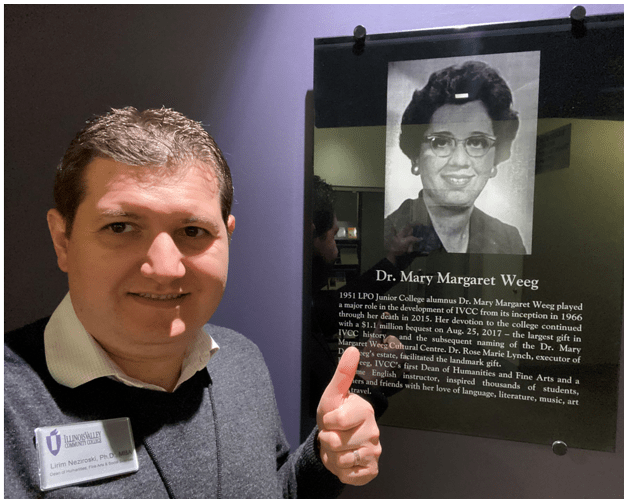
On the second night, I stuck to the main routes, and I had a little more fun. I took a selfie at the selfie station, I visited the Library and the Writing Center, and I hung out with my office predecessor – Mary Margaret Weeg, the first dean for my academic division. Dr. Weeg donated a large portion of her estate to the college, and this financed the college’s theater auditorium, which we call the “Cultural Center.”
While walking around, I saw many engaging classes. In the Career & Technical area, I overheard an instructor explain how to verify the IP address of a networking device. In a computer lab, I saw students eagerly looking at instructions on the projection screen. In a large lecture room, I saw that all students were sitting in the front row. Admittedly, many of these classes had very few students – one had only two, another had only four – and, as an administrator, I caught myself thinking, “These are not profitable classes…”
But then I remembered my own evening classes. I taught as an adjunct for seven years, often a Wednesday evening class and low-enrolled Summer classes. These classes had only six to eight students, and they didn’t all attend every session. Nevertheless, these classes were really fun. I put aside my lecture-based teaching style and my PowerPoints, and I spoke to students directly, as one person speaking to another. I still had a list of talking points I wanted to address – important concepts and vocabulary, my analysis of the assigned reading, suggestions for completing the assignment – but I got to them whenever the conversation took us there.
This approach changed my teaching style. It shifted from a collection of prepared remarks to something like an organic conversation with occasional mini lectures (which I used when I saw an opportunity to expand on a topic). This change allowed me to become more responsive to student needs. When I saw that they understood something, I quickly summarized my prepared remarks and moved on. When students were confused or had questions, I used my prepared remarks to clarify and inform.
This approach made the class more engaged. By avoiding the lecture and the PowerPoint, there was no opportunity for students to sit back and passively listen. Instead, they had to talk. And, as they talked, I assessed their understanding, and I responded. Doing this made the instructional material come across as an individualized lesson. It wasn’t a prepared/canned lecture – well, it was, but I broke it up into little pieces, and I delivered the information when needed. In doing so, I still pulled up a PowerPoint, I referred to the textbook and online images, and I drew diagrams on the board, but it all felt responsive – in response to a student need or inquiry, not driven by the instructor’s need to cover a certain set of material.
This experience also made me reaffirm a long-established truth about teaching: teaching is a relational experience. As we teach, we don’t only deliver data and information; we don’t only define terms and explain concepts. We build a relationship with students, and we use that relationship to inspire, support, and teach. And the stuff we teach isn’t only content. It’s an analytical strategy and a synthesized version of the information – a worldview. It’s also an ethos – a sense of character and the values we bring to the discipline.
Like all relationships, the student-teacher relationship is created through meaningful time spent together. Being attentive, demonstrating that you care, bringing value to the conversation, and so many more qualities count in this relationship. This understanding – that the work of education is done through relationship building – has influenced my online teaching and my administrative work as well. As an online teacher, I build instructor presence by including information about me, by creating my own videos, by communicating with students (via email, announcements, and assignment feedback), and by speaking about my own learning journey. As an administrator, I try to listen and respond thoughtfully, I try to show respect and dignity by being attentive and by giving someone my full attention and presence. In my view, anyone can do the administrative tasks of budgeting and scheduling and document signing, but what matters is how well the administrator understands your needs and goals and how well they treat you and advocate for you.
Lirim Neziroski, Ph.D., MBA is a higher education administrator, education consultant, and previous faculty member with expertise in higher education leadership, instructional technology, curriculum development, academic assessment, online programs, and strategic planning. Contact Lirim for consulting, research, writing, and public speaking services.


 Lirim Neziroski
Leave a reply to Lirim Neziroski Cancel reply