The “Byronic hero” is a character type that appeared in Lord Byron’s poetry between 1812 and 1819, and it influenced literary characters throughout the 19th century. In this post, I will describe the Byronic hero and its legacy, and I will argue that it influenced David Ball’s depiction of the Tuareg in his novel Empires of Sand.
The Byronic Hero
The Byronic hero is an aristocratic character of noble birth, who has a mysterious, possibly criminal past and very strong feelings, usually of depression and guilt. The Byronic hero is an intelligent character with striking good looks and a strong will. He is usually special in some way — sometimes in leadership of others, other times in knowledge of the dark arts.
At one point he was also deeply in love, usually with a woman he should not have loved. And, often, the woman he loved suffered greatly because of her love for him. Because of this, the Byronic hero feels responsible for her loss, and he is usually deeply depressed and melancholic; often, he gives up on life, and he lives in hiding, in disguise, or in religious monasteries.
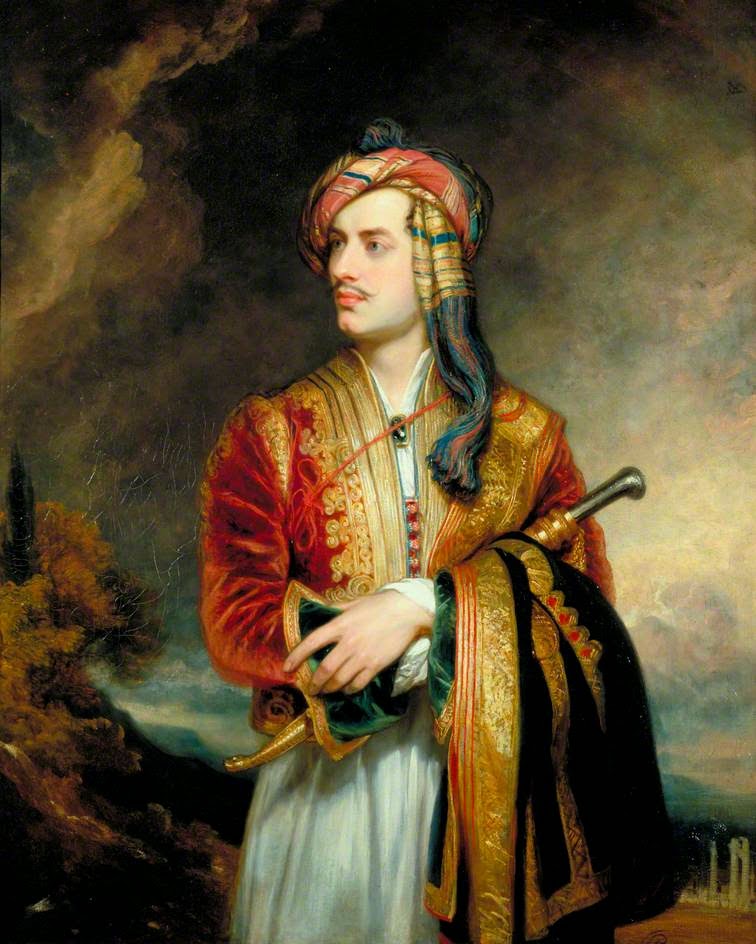
The Byronic hero first appeared in Lord Byron’s 1812 poem Childe Harold’s Pilgrimage, a semi-autobiographical poem about a bored aristocratic young man named Childe Harold who takes a tour of Europe from England to Portugal and Spain, and then to Albania and Greece. The poem is based on Lord Byron’s own travels to these countries in 1809-11, and it includes both descriptions of the travels and also reflections on the condition of Europe during the Napoleonic era.
The poem depicts Harold as a bored (and overly-privileged) aristocratic young man (of “lineage long”), who has become tired of his life of luxury in England and wishes for adventure in Europe. The poem says that Harold is “sick at heart,” and he “felt the fulness of satiety.” This is mostly because of his sinful life (“he through Sin’s long labyrinth had run”) and also because the girl he loves does not love him in return. Now, “from his native land [he] resolved to go, | And visit scorching climes beyond the sea.” He is also looking “for [a] change of scene[ry].”
This is the first depiction of the Byronic hero (though earlier versions include the Gothic villain and the German Romantic hero), so it is not developed in a lot of detail. But Byron sustains Harold’s depressed mood throughout his European travels, and the character comes to represent the general feeling of Europeans during this time. Important characteristics of the Byronic hero from Childe Harold include:
- noble, aristocratic character with a long family heritage
- a dark, somewhat sinful past he is trying to run away from
- a depressed, melancholic attitude
- a personal depression that reflects the general feeling of Europe during the time
More Byronic Characters
Childe Harold was a HUGE success for Byron. The book sold out immediately, and he commented that he “woke up famous” because of it. Afterwards, he wrote several other poems with more leading characters who had a mysterious past. Some of the most famous that I enjoy reading and studying are “The Giaour,” “The Corsair,” and “Manfred.”
The Giaour

The Giaour, who doesn’t have a name in the poem, is a Christian character in Islamic Turkey. “Giaour” is an offensive word for someone who is a non-believer or an “infidel” (because he was not a Muslim). In this poem, (spoiler alert!) the Giaour, who has “a noble soul and lineage high,” laments the loss of a woman named Leila. She fell in love with him (though she was part of another man’s [Hassan] harem), and she was drowned because of her “double treachery” — for being unfaithful both to Hassan and to her religion.
Throughout the poem, the Giaour feels intense longing for Leila and also intense guilt (“woe without name – or hope – or end”). The poem is famous for how it depicts this intense misery. At one point, the poem compares the mental anguish of Leila’s loss to a scorpion that’s surrounded by fire – the scorpion may burn to death because of the fire, or it may sting itself and burn through suicidal poison. In another part, the poem describes the Giaour’s mental anguish as “fire unquenched, unquenchable – around – within – the heart shall dwell, nor ear can hear, nor tongue can tell the tortures of that inward hell.”
On a political level, Byron also equates the Giaour’s feelings for the loss of Leila to the feelings that Europeans have over the loss of Ancient Greece — Greece at this time was colonized by the Ottoman Empire.
Conrad – The Corsair
A “corsair” is a pirate, and Conrad is the captain of a pirate ship. The story of this poem is somewhat complicated, and Conrad is not as aristocratic or depressed as the other Byronic heroes, but this is another poem that immediately sold out (10 thousand copies on the first day!) and became one of Byron’s most famous characters.
In the poem, Conrad’s wife fears for his life, and she pleads with him not to attack another town. Instead, he attacks another city, and he becomes involved with another woman who saved his life and he helped escape. During this time, his wife dies of grief, and he feels guilty because of it. The poem ends with Conrad sailing away, his “thousand crimes” somewhat redeemed by his love-guilt for his wife. I admit that this story and character are not as interesting, but Byron sold many copies, so it was an influential poem in his time.
Manfred
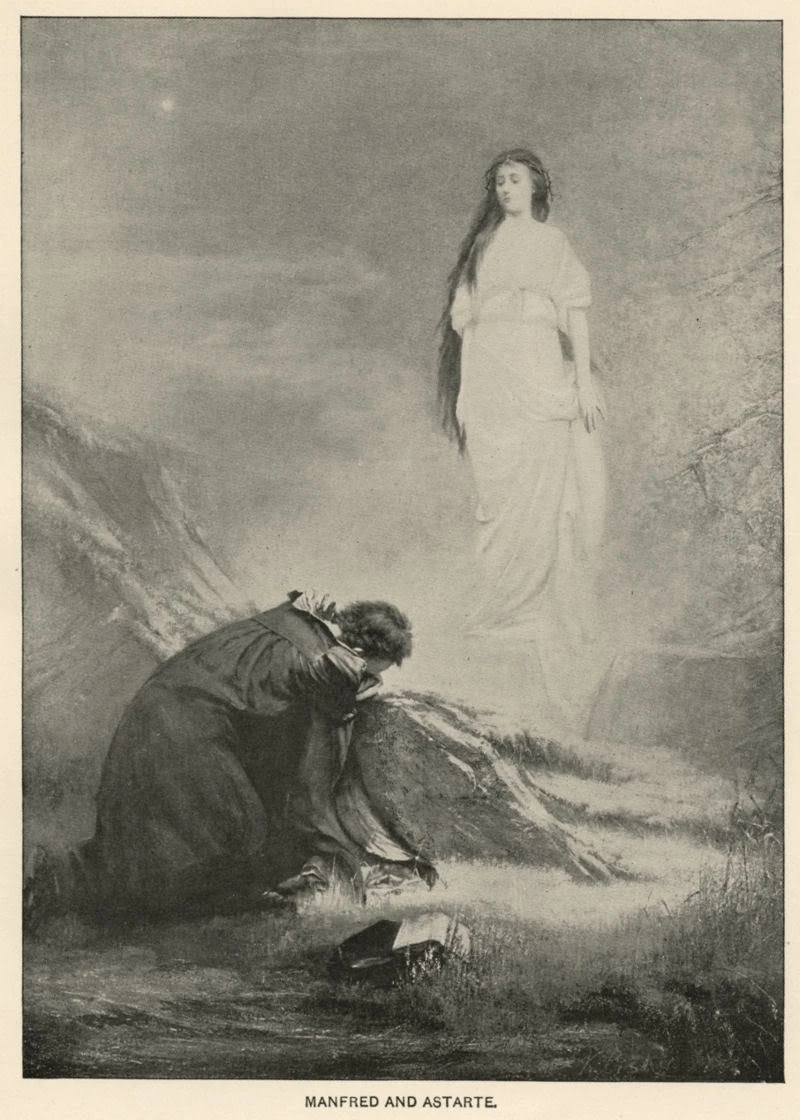
Manfred is the main character of Byron’s mysterious dramatic poem “Manfred,” and he is the last major Byronic hero who has similar characteristics as Childe Harold and the Giaour. Manfred is an aristocratic character who, like Dr. Faustus, has an advanced understanding of the supernatural world. He can speak with supernatural forces, and he has the power to call them at will.
Throughout the drama, he longs for “forgetfulness.” At one point, he loved a girl named “Astarte” very deeply, and – it is not clear why – but she is no longer living. The drama suggests that he is both guilty and mournful for her loss. But the supernatural spirits cannot calm his tortured mind, and, like the other Byronic heroes, he lives in a constant state of mental torture.
Eventually, Manfred learns that it is possible to have a few small joys in life – and this eventually inspires Byron to start writing a different kind of poetry – one that celebrates joy rather than only mourning for what is lost.
The Influence of the Byronic Hero
The Byronic hero became a well-known character, and many other novels (especially after Byron’s death in 1824) were influenced by the Byronic hero (and by Lord Byron himself). The character lives on in popular depictions of tortured artists and creative geniuses, but also of mysterious aristocratic characters and even vampires!
In fiction, the most obvious examples of characters influenced by the Byronic hero include:
- Victor Frankenstein from Mary Shelley’s Frankenstein
- Heathcliff from Emily Brontë’s Wuthering Heights
- Rochester from Charlotte Brontë’s Jane Eyre
- Dorian Gray from Oscar Wilde’s The Picture of Dorian Gray
- the Hunchback from Victor Hugo’s Hunchback of Notre Dame
- Stephen Dedalus from James Joyce’s The Portrait of the Artist as a Young Man
Check out the list of books, movies, and TV shows with Byronic heroes on these websites as well:
- Goodreads Byronic Hero list
- Byronic Heroes in Contemporary Fiction and Science Fiction
- Examples of Byronic heroes
- “Top 20 Bad Boys” and “Literary Crushes” – several posts on The Silver Petticoat Review: Part 1, Part 2, Part 3, Byronic Heroes in Film, Byronic Hero in Sci Fi and Fantasy.
Byronic Hero in Empires of Sand
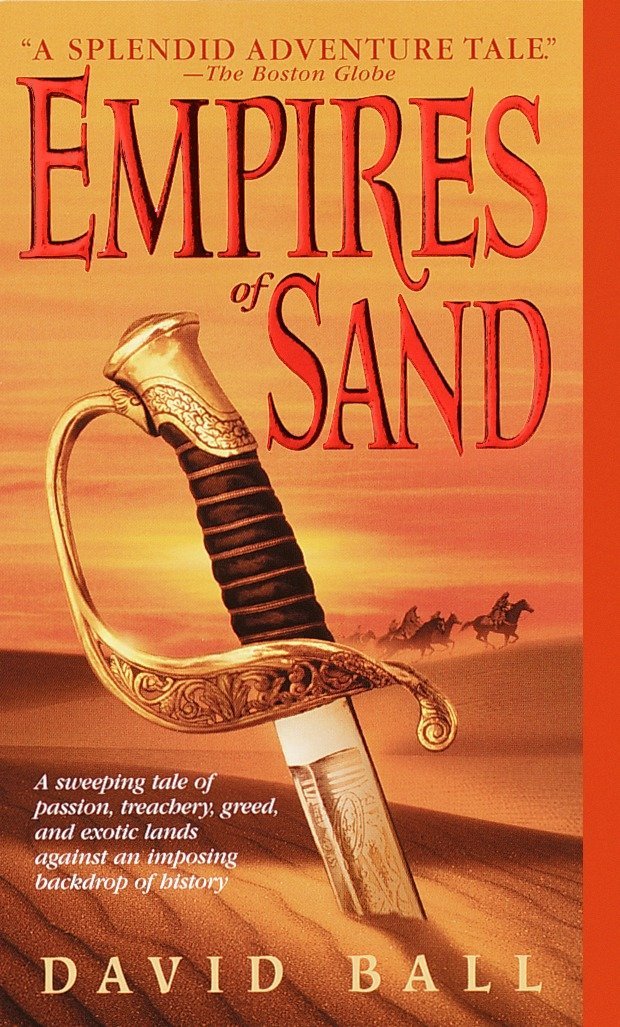
David Ball’s Empires of Sand (1999) is a grand epic novel about the deVry family, one of the wealthiest and oldest (fictional) families in Paris. The novel focuses on two generations, and it is split into two locations and time periods. The first part is set in 1860’s Paris, and focuses on Henry (an aristocratic adventurer) and his brother Jules (a general in the Emperor’s Guard). The second part is set in the Sahara Desert of the 1870’s and 1880’s, and it focuses on Moussa (Henry’s son, who has joined his mother’s tribal society of “the Tuareg”) and Paul (Jules’s son, who has joined the French colonial army and is exploring the Sahara Desert for a railroad expedition).
Throughout the novel, the Tuareg (who are desert nomads and warriors) are described as majestic, noble characters who are “lords of the Sahara” but also mysterious and violent. They wear blue robes that completely cover their bodies (except for a small opening for the eyes), hence their mystery … because you cannot see their faces and because they hide weapons in the folds of the robe. They ride their camels like royalty, they own slaves and perform no manual labor, they live by a warrior code, and they dictate the terms of trade for anyone carrying goods through the desert.
“Tuareg nobles were not born to do work. They were born kings of the desert. Born to lead, to command, to fight. They played games and composed poetry and raced camels and lived off the labors of their vassals…”
Many Tuareg characters, particularly Moussa, are described like African kings: tall, strong, lean, muscular, confident, and attractive. Moussa’s cousin Mahdi, who causes a lot of trouble for both Moussa and Paul, comes across very much as a Byronic hero. His Byronic-hero characteristics include:

- His aristocratic rank as the son of the Tuareg leader, part of the warrior class, “of excellent lineage,” and very wealthy.
- His skills as a warrior and military leader – he is very accomplished and greatly feared.
- His attraction to other women in the Tuareg community.
- His ability to be both a fierce warrior and a gentle, poetic (romantic) partner, particularly the intense love and commitment he shows to Daia.
- His suffering in love. Daia does not love Mahdi with the same intensity he loves her; she passionately loves Moussa, even though she is engaged to Mahdi.
- His violent, unstable, and “hard” personality – “quick to temper,” a tongue as sharp as his blade. The novel (and other female characters) suggest that Daia’s love can “tame” his spirit.
I recently finished reading the novel, and many descriptions of the Tuareg, as well as specific descriptions of Mahdi and Moussa, reminded me of the Byronic hero. If you are interested in learning more about the Byronic hero, or if you recognize Byronic heroes in other novels, film, and TV shows, post a comment below.
Lirim Neziroski, Ph.D., MBA is an academic administrator and faculty member with expertise in instructional technology, curriculum development, assessment, and strategic planning. He is also an English and Management professor, with a specialization in 19th-century British literature. Contact Lirim for resources and for speaking, consulting, and writing opportunities.
 Lirim Neziroski
Leave a reply to 2020 Books I Read – Fiction – Reflections on Higher Education Cancel reply