What are Assessment Plans and Assessment Reports, and how are they different from each other? Both Assessment Plans and Assessment Reports describe how Student Learning Outcomes are assessed, but the two documents provide different information, and they are written at different times in the assessment process. In this two-part blog post, I will describe the basic features of Assessment Plans and Assessment Reports.
An Assessment Plan is a document that describes how and when Student Learning Outcomes will be assessed. It describes an assessment process that will occur in the future. The Assessment Plan is written once every three or five years (depending on the program’s accreditation or program review cycle), and it typically has the following sections:
Program Information. The very top of the Assessment Plan usually provides identifying information, such as the full name of the academic program, the academic department or college it belongs to, the name of the assessment coordinator or faculty member writing the assessment report or the name of the lead faculty member for that program. The assessment plan will also usually have the date it is being written and the years in the assessment period. For example, the assessment plan may be due on October 1st, and the plan may be used in 2020-2023.
A List of Program Outcomes. The Assessment Plan lists all program outcomes, usually at the top of the document. Programs usually have about four to eight program outcomes. This document may be the official place where program outcomes are stored.
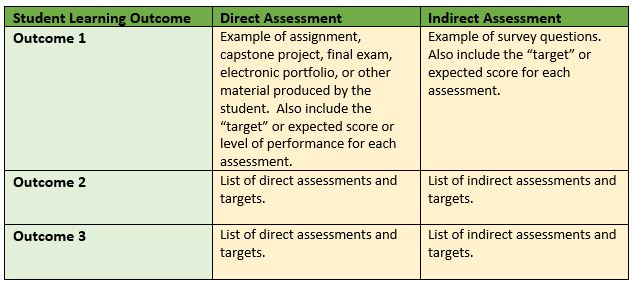
Alignment of Program Outcomes with Direct and Indirect Assessments. This is one of the most important sections of the Assessment Plan. In this section, each program outcome is listed individually, and each Direct and Indirect Assessment is listed below or to the side. This section lists the assessment “instruments” that will be used to measure the program outcome. When it’s time to assess the outcome, this section provides a guide for what data to consider. The alignment is usually presented in a table, like the images below. Here are a few real examples as well: University of St Francis, University of North Carolina, Northern Illinois University.

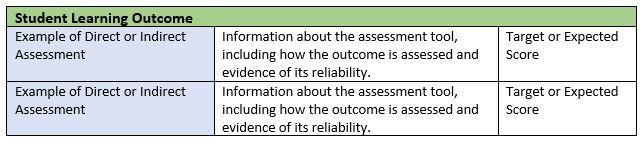
Assessment Description and Validation. The Assessment Plan usually also provides information about the assessment instrument, including a description of the instrument itself (whether assignment, exam, capstone project, clinical skill, survey, etc.), what the instrument measures, and the how the outcome is assessed. This section may also provide evidence that the assessment instrument is reliable.
Benchmark or Expected Goal. Each assessment usually also includes an expected goal, called a “benchmark” or a “target.” The benchmark acts as a cut-off score that helps assessment coordinators determine if students have achieved the learning outcome. For example, if a program outcome is being measured with a final exam, a score of 80% for each student may be the benchmark. The student will meet the outcome if he or she scores 80% or higher on the final exam. Additionally, there may be another benchmark for how many students need to receive a score of 80%. So, the benchmark may be “80% of students in NURS 205 score 80% or higher on the Final Exam.” The benchmark score is usually listed next to the assessment instrument on the spreadsheet.
Assessment Schedule. The schedule follows the alignment of outcomes and assessment measures. This section indicates when each outcome will be assessed. The assessment period varies from institution to institution, but it is usually three to five years, and it usually corresponds with the program’s accreditation or program review cycle.
Most programs assess two or three outcomes each year; for example, if the program has six outcomes, it will assess two outcomes each year for three years. Sometimes a program may choose to assess an outcome more than once during the assessment period. For example, the program may scatter assessment of the six outcomes over three years so that each outcome is assessed twice; the program would be assessing three outcomes each year. Some programs are required to assess every outcome every year; however, they may alternate the assessment methods each year. Meanwhile, other programs assess every outcome every year with all available assessment measures. The tables below show some examples.

Approval Information. The Assessment Plan may also include information about when the document was submitted for review, who reviewed or approved it, and when it was approved. This section may include signatures or comments from the department chair, the assessment coordinator, the dean, or the assessment committee.
Lirim Neziroski, Ph.D., MBA is an academic leader and an assessment and technology expert at a liberal arts university in the Chicago area. Contact Lirim directly for additional resources and speaking, consulting, and writing opportunities.


Leave a Reply