In this blog post, I am continuing my description of recent workshops and conferences I attended. In May, I attended the NISOD Conference on Teaching & Leadership Excellence in Austin, TX, and I gave a conference presentation about the College Consortium, an online course sharing platform.
NISOD Conference
The annual conference provides resources to community and technical college administrators, faculty, and staff. Events included pre-conference workshops, an awards banquet, two keynotes, an exhibit hall, an administrative series, and breakout sessions all day.
I attended the two keynotes, a few administrative series sessions, and several breakout sessions. Most of the presentation topics I attended focused on faculty development. I will write about the faculty development sessions in a separate post. In this post, I would like to describe the two keynotes.
Keynote: John O’Brien, President/CEO of EDUCAUSE
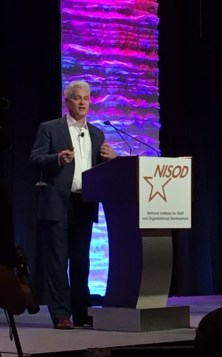
The first keynote address was by John O’Brien, President/CEO of EDUCAUSE. EDUCAUSE is a non-profit organization that promotes the effective use of technology in higher education. Each year, EDUCAUSE publishes its “Horizon Report,” which describes tech teaching trends in higher education. EDUCAUSE also has an annual conference (the 2019 conference will be in Chicago) and several other publications about technology and higher ed. John O’Brien has served as a Senior Vice Chancellor at Minnesota State Colleges and Universities, President of North Hennepin Community College, Chief Academic Officer and Acting President of Century College, and several teaching positions.
O’Brien’s keynote presentation, titled “The History of the Future of Educational Technology,” focused on several past predictions about the future of education, and it compared these predictions to today’s predictions about online instruction and artificial intelligence.
 A recurring image throughout the presentation was this image of an audio book converter which converted printed books (through a hand-cranked machine) into an audio book. John’s presentation commented on how images like this one depicted the future of learning with the use of machines. John also found it interesting that each futuristic image contained many aspects of the current time period. For example, this image uses a hand crank to convert books into audio; the tables and floorboards also look 19th-century rather than futuristic.
John claimed that many futuristic images include the hopes and imagination of the era, but they also contain embedded critiques. For example, John showed images of computers teaching students, but some students were using the computer to play games. Other images also critiqued the futurist idea by illustrating how gender differences and stereotypes are advanced into the future time period. Images like these suggest that education will not be free of cultural ideologies even if human teachers are replaced with technology.
For more examples of “paleo-futurism” (the study of how “the future” was predicted in the past), read Audrey Watters’s “The History of the Future of Education.” See also the list of paleo-futurist articles on the Hacked Education blog archives page.
NISOD-ACUE Partnership
At the keynote presentation, NISOD announced a new partnership with ACUE to promote faculty development. NISOD is now offering the ACUE workshop in faculty development, where participants can earn a Certificate in Effective College Instruction, which is a nationally-recognized teacher-training certificate.
Keynote: Saundra McGuire
Saundra McGuire is a leading expert on “metacognition” (the study of how students think about or reflect on their own learning process) and author of Teach Students How to Learn and Teach Yourself How to Learn. She is also a retired Vice Chancellor, Chemistry Professor, and Director of the Center for Academic Success at Louisiana State University.
Her presentation described how colleges can help students learn by incorporating metacognition practices in the classroom and in academic support departments. Much of her presentation also provided examples of students and schools that have benefited from her team’s support. Her full presentation can be found here.
In subsequent posts, I will provide summaries of a few breakout sessions I attended, including a session by Gary Schoeniger of the The Entrepreneurial Learning Initiative. This was also my first trip to Austin, TX, and I would like to share a few initial impressions of the city as well.
Lirim Neziroski, Ph.D., MBA is an academic leader and an assessment and technology expert at a liberal arts university in the Chicago area. Contact Lirim directly for additional resources and speaking, consulting, and writing opportunities.
 Lirim Neziroski
Leave a reply to NISOD 2019 Part 3 – Reflections on Higher Education Cancel reply