In this blog post, I am continuing my description of Spring workshops and conferences I attended. In May, I spoke at the NISOD Conference on Teaching & Leadership Excellence in Austin, TX.
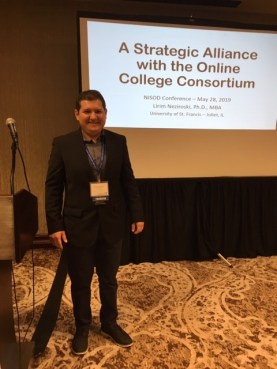
A Strategic Alliance with the Online College Consortium
My presentation focused on my school’s partnership with the College Consortium. The College Consortium is an online course sharing platform that helps schools enroll students from other colleges. The College Consortium (which is not a college or a consortium) facilitates communication, student enrollment, financial management, and course transcripting between schools.
The Consortium began as a facilitator of one-to-one consortial agreements between schools. It helped institutions connect to each other, develop consortial agreements, communicate student information, and process financial transactions. More recently, College Consortium has joined with established academic consortia, such as the Council of Independent Colleges, which it joined in January 2019, and its consortial services have become available to hundreds of schools in the CIC consortium. This rapid growth in the availability of online course sharing has made several headlines in national news media (including in The Chronicle of Higher Education, Inside Higher Ed, Ed Surge, and more).
My university was an early partner of the College Consortium, and I serve as one of the contract managers and administrators of Consortium services on campus. My presentation shared the many benefits my school has experienced from our participation in the Consoritum.
Participating in the College Consortium
Institutions that participate in the Consortium can participate in two ways.
- The first way is to participate as an “Enrolling Institution,” which means that students from your school will use the Consortium to take online courses at another school. This is similar to a traditional transfer course, but the consortial agreement provides several benefits that are not included in traditional transfer courses – see below.
- The second way is to participate as a “Teaching Institution,” which means that online courses at your school are open to students from other schools.
College Consortium provides students with several benefits that are not available with traditional transfer courses. These include the ability to use financial aid and to count the Consortium course in the GPA. Institutions also benefit because they have greater control over the quality of transfer courses their students take.
Benefits to Enrolling Institutions
“Enrolling Institutions” provide the following benefits to their students:
- The Consortium course counts as part of the student’s course load. In traditional transfer courses, students cannot use the credit hours of their course (which they usually take at a local community college) as part of their home institution. This means that students have to take the transfer course during the summer, or they take an overload or drop to part-time status during a regular semester. By including the transfer course as part of the home institution, the student is able to take the class when needed and avoid extra, unnecessary “schedule filler” classes.
- Students can use financial aid for Consortium courses. Consortium courses count as normal courses offered by the home institution; they don’t count as traditional transfer courses. This allows students to use their institution’s financial aid.
- Consortium courses count as part of the GPA. Since Consortium courses are considered the same as courses offered by the home institution, the student’s grade adds into the GPA calculation. This benefits students who take lower-level General Education courses and use those courses to boost their GPA. It also prevents students from “blowing off” a General Education course they take at a community college over the summer; now, their grade, and not only the course credit, counts!
- Consortium courses have variable schedules. Several schools have only regular full-semester or eight-week courses, but a student may need a course at a different time. For example, a student withdraws from a full-semester course and enrolls in an eight-week course (to maintain full-time status and athletic eligibility), but what happens if the student’s course is not offered as an eight-week class? The student enrolls in a class he/she does not need only to maintain full-time status. As you can guess, this student would be uninterested/unengaged in the course, and the student is using financial aid unnecessarily.
Enrolling Institutions also benefit in other ways:
- Higher Revenue and Enrollment Numbers. Enrolling Institutions charge their own course fee for the Consortium course, and they may keep a portion of that course fee as their profit; additionally, the home institution can count enrollment in the Consortium course as enrollment in their courses. With traditional transfer courses, both revenue and enrollment numbers go to the other institution.
- Higher student retention. Complications happen, and, if the university doesn’t have a way to accommodate student schedules, students may drop out. The Consortium allows schools to offer online courses that can work with a variety of student schedules.
- Higher graduation rates. The ability to help students enroll in online courses that meet their needs can help them complete a degree and earn a diploma. Advisors can even reach out to students who have stopped attending and develop a customized pathway to graduation using online Consortium courses.
- Alternative to running courses with low enrollment. If a course consistently attracts only two or three students, it may be more sustainable and more effective to find a Consortium course for those students than to run a course with only two or three students. Running a course with only two or three students is costly for the university, and students won’t benefit from group learning with other students.
- Offer a greater variety of courses for exploration. Students who are interested in unique courses that are not offered by the university may be able to take a special topics course for equal credit through the Consortium.
- Offer additional program concentrations. A small school may not be able to offer more than two or three concentrations in a program, but the school could use Consortium courses to create a different concentration (this would need accreditation approval first!). For example, a school may offer Finance, Accounting, and Business Administration as concentrations for a Business degree/major, but it may not have concentrations in Management or Economics. The Consortium may help the school build a Management or Economics concentration with the use of Consortium courses.
- Other benefits: lack of faculty, last-minute faculty resignations, avoiding course overloads, program teach-outs, etc.
Benefits to Teaching Institutions
A school becomes a “Teaching Institution” in the College Consortium when it opens its online courses to students from other schools. The process for this involves adding course information to a spreadsheet and uploading it to the Consortium webpage. (I will provide more information about hosting online courses through the College Consortium in a future post.)
Schools that participate in the College Consortium as “Teaching Institutions” make their online courses available to other students. They do this primarily to attract more students in the course to increase their student enrollment numbers and to generate additional revenue. In some cases, Teaching Institutions can create partnerships with other institutions.
Benefits for hosting online courses through the College Consortium include the following:
- Increase Enrollment and Revenue. The College Consortium makes it possible to recruit students from other schools, and this increases your school’s enrollment and revenue.
- Fill empty seats. In some cases, your school may be able to enroll several students from the Consortium and enable the class to run. For example, one course at my school had only two of our students but four Consortium students. It was easier to gain administrative approval for running a course with six students than it would have been for running a course with two students. Without this higher enrollment, the course would have probably been cancelled, and our students would have had to wait a semester or to enroll as transfer students at another school.
- Greater marketing. Other people see your school’s information on the College Consortium website, and they may be interested to learn more.
- Community partnership opportunities. Local schools frequently talk about opportunities for course sharing, and the College Consortium can provide the platform. A school that’s already hosting courses through the Consortium has a strategic advantage for recruiting these students. Additionally, private and religious schools may use the College Consortium to create course sharing partnerships that are mutually beneficial.
These are a few of the benefits I spoke about at my presentation. In future posts, I will provide more information about other aspects of the College Consortium, including the process for enrolling students, assuring the quality of courses, and strategies for effective use of the Consortium. I will also post additional information about other presentations I saw at the NISOD Conference. Please use the Contact link at the top of the page to request additional information about my presentation or about College Consortium more generally.
Lirim Neziroski, Ph.D., MBA is an academic leader and an assessment and technology expert at a liberal arts university in the Chicago area. Contact Lirim directly for additional resources and speaking, consulting, and writing opportunities.
 Lirim Neziroski
Leave a reply to Quality Assurance in the College Consortium – Reflections on Higher Education Cancel reply