In this blog post, I am continuing my description of Spring workshops and conferences I attended.
In May, my colleague (C. Andrew Glenn) and I attended the “FSI: Intersection of Teaching, Learning, and Technology” Conference at the University of Illinois (see FSI website). We presented on how we manage course development contracts using DocuSign and Quality Matters.
The Conference
The FSI Conference was originally the “Faculty Summer Institute,” but it has now expanded into a regional education conference. We attended both conference days on May 21-22. The conference did not have an official theme, but the two keynotes spoke about engaging Generation Z students with technology in the classroom.
The Keynotes
The first keynote address was delivered by Colin Suchland, Professor of Sociology at Lincoln Land Community College and SOCS Assessment Coordinator. Dr. Suchland provided information about the impact of social media and online digital media on the learning habits of today’s students. He also described attitudes and skill levels of students from different generations. Afterwards, he provided examples of teaching strategies that engage students with technology in the classroom.
Specifically, Dr. Suchland talked about how information on social media such as Facebook has become the “dominant window of the world” – the platform of choice students use to learn about the world. He described how YouTube has become the dominant video platform for news, information, and entertainment. In terms of generational differences, he said that students are comfortable using technology, and even “embrace” technology; younger students integrate technology more fully into their lives by using apps instead of websites and online videos. However, some of the drawbacks for so much technology use is a lack of familiarity with social etiquette and an inability to find high-quality sources of information.
At the end of the keynote, Dr. Suchland provided examples of how instructors can incorporate technology into the classroom. One group activity we participated in was a study of gender stereotypes; we analyzed differences in colors and types of toys sold on Amazon. Each audience member found a toy on Amazon and completed a Google survey which asked about whether the toy was for a boy or girl, its color, and the type of toy. Predictably, girl toys were mostly dolls and clothing/make up and pink, while boy toys were vehicles or weapons and used blue or camouflage colors. This simple activity showed that beliefs about gender influence the design of kids toys. Other suggestions Dr. Suchland offered were to experiment with class activities, to use social media to stay connected with students (he has an active Twitter account), and to be aware of student technology accessibility issues.
The second keynote was delivered by Alison Doubleday, Associate Professor of Oral Medicine and Diagnostic Sciences at the University of Illinois at Chicago (UIC) College of Dentistry. Dr. Doubleday described a classroom assessment strategy she called “pedagogical sleuthing” where instructors pay careful attention to subtle, difficult-to-identify student learning indicators. She argued that teachers should become familiar with a range of student learning behaviors and to use observations of student learning as evidence to improve the classroom environment. These subtle indicators of learning include student body language, written responses, attitude, confidence, engagement, time on task, and many more.
Throughout the presentation, Dr. Doubleday described effective classroom environments that promote student learning. These include independent class activities where students control the learning, opportunities for undivided focus, attention to emotional responses, opportunities for teacher-student interaction, and opportunities for student reflection on learning. At the end of the session, Dr. Doubleday described several small changes in her lab classes that promoted student attitude and learning.
Find more information about both speakers at the FSI Keynote page, or at each speaker’s website: Colin Suchland and Alison Doubleday.
Our Presentation
My colleague, C. Andrew Glenn, Learning Designer at the University of St. Francis, and I delivered a presentation as the FSI Conference about how our institution uses DocuSign and Quality Matters to manage and improve the process for developing online courses. (Download the full presentation here.)
At our school, online courses get developed through a formal process. The academic department requests the help of our learning designer, and we create a formal work contract using DocuSign. The document is signed by the academic dean and by the instructor; these signatures establish a formal work-for-hire contract, and the course development begins.
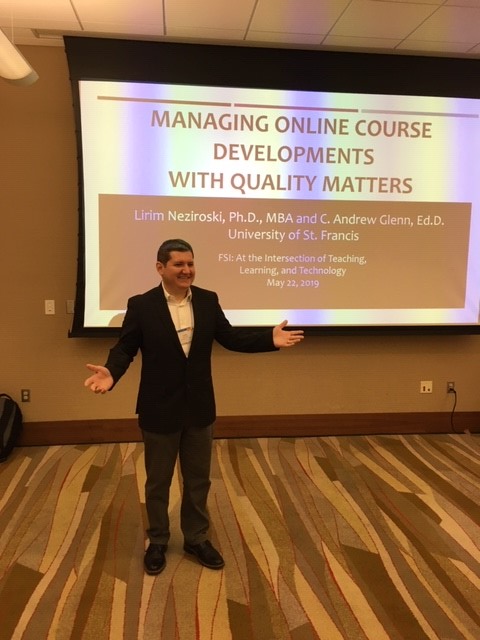
Afterwards, the learning designer and the instructor develop online course content using Quality Matters standards as a guide for the instructional design. During our presentation, C. Andrew spoke about the specific responsibilities of both the learning designer and the instructor. For example, the learning designer creates a course development template on the online platform, while the instructor creates the syllabus, writes learning outcomes, submits the course to the university for formal approval from shared governance committees, selects the textbook, and develops assignments and exams.
After the online course is fully developed, the learning designer signs the DocuSign contract to indicate that course development is complete and that the online course follows the Quality Matters standards. Afterwards, the Quality Assurance Manager at the college reviews the online course to verify that it meets curricular requirements. This includes reviewing course content for accuracy and reviewing assignments for assessment and curriculum mapping. Once this is complete, the Quality Assurance Manager signs the contract, and the course is available to students.
Our presentation also described how this process has helped the university, challenges we have experienced, and recommendations we can make. Feel free to contact me using the Contact link at the top of the blog if you would like more information about using Quality Matters. I can also provide consulting services if your school would like help setting up a Quality Matters course development process.
In my next post, I will describe additional conference sessions I attended.
 Lirim Neziroski
Leave a reply to FSI Conference Part 2 – Reflections on Higher Education Cancel reply