The beginning of the semester is often the time instructors put together the course syllabus. What should go in a syllabus? Here is a description of the most common components in a college course syllabus. I have grouped the components into categories.
Instructor Contact Information and Availability
The instructor’s contact information and their availability for meetings are among the most important pieces of information in the syllabus. The syllabus is often the only document students have that lists the instructor’s contact information. The syllabus can also allow instructors to introduce themselves to their students and to establish guidelines for communication. Here are suggestions for what to include.

Name or Preferred Name – Instructors include their name and what they prefer to be called, especially if they want to go by a middle name, shortened name (ie, Beth instead of Elizabeth), a first-name basis, or an official title (ie, “Dr” or “Professor” or “Mr”). For example, when I taught, I asked that students refer to me as “Dr. Nez” – it was easier than my full last name and more formal than my first name.
Pronouns – It is now common for people to disclose their pronouns in parentheses an in lower case after their name, such as (he/him) or (they/their). The pronoun disclosure allows instructors to express themselves, and it also sends a supportive message to students by demonstrating that the instructor is in-tune with the current conversation about gender inclusion.
Academic Credentials – It’s common in higher education to list academic credentials, such as Ph.D. or Ed.D. These can help establish the instructor’s credibility by identifying the instructor’s level of expertise.
Pronunciation Guide – Some instructors include a phonetic pronunciation guide for their name.
Email Address – The college / university email address is a vital and probably the most common and primary method of communication.
Phone Number – The office phone number is another common method of communication. Many instructors also list their personal mobile number, especially if they are a part-time instructor who don’t have a phone number on campus. Alternatively, instructors could use an online number through an app such as Google Voice, or they could use texting software such as Remind.
Office Location – Building and Room Number of the Faculty Office. Instructors may also choose to meet in a science lab, the tutoring or writing center, the library, or a public area such as the campus cafe. Part-time instructors may not have access to a private office, so they may need to list a department office or reserve time in a campus meeting space.
Office Hours – These hours designate days and times the instructor is available to meet with students, either in-person or virtually, and they are sometimes called “student meeting hours.” Many colleges require that instructors identify a set number of hours throughout the week, such as five hours spread out over three days. During these times, instructors should be easily accessible and available to meet with students. Meeting times should be reasonable and convenient, and instructors should aim to meet with students, rather than run errands, have lunch, grade papers, or write their scholarship. Traditionally, instructors invite students to meet with them during these hours for individualized mentoring and homework support, and the meeting times are at convenient hours such as before or after class. Office hours get complicated when an instructor teaches back-to-back classes, when they teach at multiple locations, and when they teach online classes. Part-time instructors are often not required to designate a specific meeting time, though many try to meet before or after class, so they often list “by appointment only.”
Link to a Virtual Conference Meeting – Many instructors teach online classes now, and they try to be available at non-traditional times in the evening, so it is useful to meet virtually via Zoom or Google Meets. Many instructors who meet virtually use the same URL web address for their “virtual meeting room.” They post this address on their syllabus, on their email signature, and in the online class. Some virtual meeting platforms can even send an alert when someone joins the meeting. Instructors who hold office hours virtually instead of in-person may be required to keep the virtual meeting room open during the whole time of the office hour.
Faculty Website – Many colleges provide webpages for instructors where they can post their contact information, academic background, teaching experience, a record of scholarship, and links to resources. The faculty webpage can provide students additional useful information about their instructors, and instructors can use these web pages to share their background and interests. In addition to a college-provided faculty web page, the instructor may also list their professional website, links to their books and published scholarship, and links to their social media platforms.
Guidelines for Communication – Instructors often include guidelines for how and when they will communicate with students. For example, many instructors require that students use their college emails or the email tool in the online course platform rather than a personal email. Instructors may also prefer an email before an office visit. They may also request that students include specific information (such as the course code) in the email. And they may provide guidelines about how quickly they will respond: a common response time is within 24 hours during the weekday and within 48 hours during the weekend. Some instructors may also specify that they don’t respond after work hours or during the weekend.
Course Assistants – Courses may also include Graduate Teaching Assistants, Research Assistants, Lab Monitors, or Clinical Instructors. Or, the instructor may partner with an Embedded Tutor or Librarian. These assistants are also usually included in the syllabus or in the online platform.
Course Information
The Course Information section includes details about the course, such as the course code, course description, and student learning outcomes. Much of this information is found on the college catalog and on the “master course syllabus,” which serves as the foundation for the instructor’s course-specific syllabus. When a college uses a syllabus management platform (such as Simple Syllabus or Concourse), this information is copied automatically.
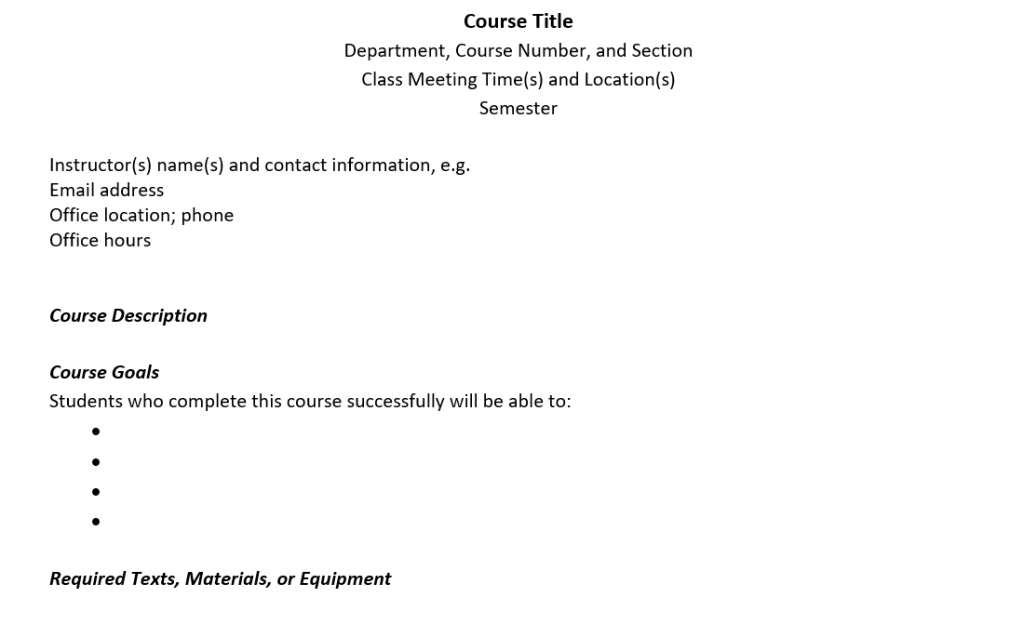
Course Code and Course Title – The number and name of the course, such as ENGL-1001 English Composition or PSYCH-1000 Introduction to Psychology. The course code is especially important because it identifies which department owns the course, and this may matter for transfer and degree purposes. Sometimes, a course may be cross-listed with more than one department, and the student will need to register for the correct course to have it count towards their degree. Instructors are also approved to teach in specific academic disciplines, so the course code also identifies which courses an instructor can teach.
Course Description – The course description provides an overview or a summary of the course. The course description is one of the most important parts of the syllabus because it explains what the course is about, its topics, its scope, and possibly its theoretical approach. For example, an Art History 2 course may have the following description: “This course provides an overview of art styles and artists from the Renaissance to the modern period.” This description identifies the time period for the course. Course descriptions are usually about three to five sentences long, and they are also often based on course descriptions from accrediting organizations or other advisory groups. For example, Illinois has a collection of general education courses in the Illinois Articulation Initiative, and many schools use the course description from the IAI as the foundation for their course description. The course description also provides guidance on instructional content and assessments covered in the course. For example, the Art History 2 course may specify that it will cover the Renaissance, Baroque, Neoclassical, Romantic, Realist, and Impressionist artistic styles, plus it will include activities and assignments related to art vocabulary, artistic style, and art analysis technique. When the course description lists all these content areas and assessments, it’s expected that the class/instructor-specific syllabus meet these requirements as well.
Textbook and Materials – The syllabus should include textbook information including the ISBN, computer software, and other materials students will need for the class. This is like the “supply list” kids have for elementary classes, where it specifies how many notebooks, folders, and crayons. College students may need specialized graphing calculators, computer software such as Java or Python, a uniform for clinical Nursing classes, and equipment such as a stethoscope or goggles.
Course Objectives (Student Learning Outcomes) – A list of what students will learn, including content items or course topics, cognitive skills such as analysis and argumentation, and behavioral or personal skills such as professionalism or ethics. A course objective is a single sentence that begins with “Students will…” and with a clear action verb such as “analyze” or “evaluate.” These verbs are often based on the Bloom’s Taxonomy of Cognitive Development, which ranges from simpler intellectual tasks such as “identify” and “describe” to more complex ones such as “analyze” and “evaluate” and “synthesize.” The sentence usually lists a course topic students will need to master or a skill they will need perform. For example, a content-focused learning outcome may be: “Students will be able to describe the process of photosynthesis in plants.” The sentence may also list a skill the student will need to demonstrate through an assignment. For example: “Students will be able to create a webpage that includes a variety of elements using HTML code.” The course objectives are one of the most important components of the syllabus because they indicate very specifically what students will learn and how they will be assessed. Course content/topics and activities and assignments are often based on the course objectives.
Course Content and Topics – The syllabus may provide a list of content items or topics covered in the course. Alternatively, this list may be included in the course description or in the weekly schedule.
Grading Information
The syllabus needs to identify the major graded items in the course (such as exams or essay) and explain the grading policies. For example, some assignments may be dropped, or some assignments must be completed in order to pass the class (even if the student successfully completed all the other assignments).
List of Required Assignments – The syllabus lists the major assessment categories (such as exams, online discussions, daily homework, and written assignments), and it provides a detailed explanation or grid that shows the percentage for each category and the number of projects. For example, it may show that students will complete four writing assignments at 15% (150pts) each, a final exam for 20% (200pts), and daily work for 20% (200pts). The syllabus usually also explains the grading scale for what is an A, B, C, etc.

Grading Policies – Graded assignments can be calculated in several ways. Each major category can be worth the same amount of points (such as 20% for exams, 20% for writing assignments, 20% for participation, etc.), or they could be weighted differently. Additionally, individual items within a grade category can be worth the same amount of points or different amounts; for example, all quizzes may be worth 10 points, or they could range from 10, 15, 20 point. Instructors can also have policies about dropping a low score on an assignment, averaging assignment grades, requiring that a specific assignment be completed, and many other unique variations.
Major Assignments – In addition to the grade information, the syllabus usually provides a paragraph of explanation for each major assignment and assessment category. For example, it may explain that all writing assignments should have a thesis, several body paragraphs, and information from outside sources. It may also describe the exams as multiple choice or short-paragraph responses and that exams focus on a single chapter or cover a larger unit. This section may also describe specialized assignments such as a Nursing Care Plan is or Group Presentation or a Reading Response. The description may also provide more specific information about what constitutes Daily Homework or Class Participation.
Grading Rubrics – Grading rubrics describe how a specific assignment will be graded. They often presented in a grid that lists the criteria, the levels of achievement for each criteria, and the specific points for each level. Grading rubrics are often presented with the specific assignment requirements, or they are posted on the online platform, but some courses use a generic grading rubric for all major assignments and this is included in the syllabus as well.
Note on Attendance – Attendance is sometimes listed as a grade category, especially in science labs, nursing clinicals, or fine arts courses. In general, though, for most traditional General Education or lecture-based courses, attendance should not be a graded category. In general, students should be evaluated on their knowledge or skill, not on their ability to attend class. So, instead of grading attendance, identify an activity the students do that be worth grading. Often, instructors can grade “in-class participation,” which may consist of class discussion or a class activity, or they can add a small graded activity such as a daily quiz or reflection assignment. Realistically, yes, these activities are only a proxy for attendance, but students have to demonstrate some skill or knowledge (or at least participate) to earn the points. When switching from attendance to participation, instructors often worry that students who don’t attend class will be asking to complete those activities. You can prevent that by having an effective Attendance Policy that would require these activities to be completed in class and on time – see below.
Course Policies
Another major section in the syllabus is the course policies section, where the instructor describes the “rules” of the class and other important information.
Attendance – For in-person classes, attendance is an important component of class. This section describes whether attendance is mandatory or only recommended, what happens if a student is absent, and whether there is a difference for “excused” or “unexcused” absences. For example, lecture classes in a large lecture hall may have a recommended attendance policy, while specialized courses such as Nursing Clinical courses may have a mandatory attendance. Additionally, students may be able to miss one or two class sessions without penalty, but they may need to have a medical excuse for more absences.
Online Navigation and Weekly Schedule – For online classes, students may need direction on how to access the online platform, where to find course materials and assignments, and generally what to do. For example, the syllabus may provide the web address to the LMS and also give instructions to read the announcements first then complete one module per week starting from the top and going through all the items in order. The syllabus may also describe how the week is managed in the online class. For example, the new module may open on Monday morning and students may have until Friday night or Sunday night to complete everything for that week. Or they may have weekly deadlines on particular days, such as the first post for discussions due by Wednesday, and the quiz due by Thursday. Other information about an online class may include guidelines for office hours, how frequently students are required to login each week, and what constitutes online etiquette and inappropriate comments.
Make up and Late Work – Students don’t always attend class or complete assignments on time, so the syllabus provides guidance on whether late work is accepted, for how long, how to submit it. Some instructors don’t accept any late work, some instructors assign a small penalty (such as one letter day deduction per day the assignment is late), and some instructors may require permission in advance. Another example of a late assignment policy is that small activities such as in-class or online discussions may not be made up, but major assignments such as written projects or exams may be completed late.
Clinical, Lab, Practicum information – Classes with specialized course components such as science labs, discussion break-out sessions, off-campus field trips, Nursing clinical courses, community service-learning projects, and others will need specialized information.
Academic Honesty – The syllabus usually includes warnings against cheating, plagiarism, and inappropriate use of artificial intelligence. Often, instructors can copy the college’s policy, but they may have to provide their own definitions, examples, and range of penalties if the college does not have a policy.
Student Resources
The syllabus usually includes information about academic and college resources students can use. This section usually provides a brief description about the office or service and contact information. Often, this information is provided by the office, and instructors can copy the language and contact information.
Academic Support Services – These include the Library, Tutoring Center, Writing or Math Center, and other services on campus that provide specific academic support related to a student’s coursework.
Disability and Accessibility Services – Schools are required to have services for students with physical or mental disabilities, and for students who are experiencing high anxiety or need an accommodation on an exam or other project. In general, students are required to meet with staff from these offices in order to receive an accommodation.
Assignment or Course Specific Resources – Classes that require specialized computer software or other resources may list resources such as an instruction manual, online technical support hotline, or video series on YouTube for students to get additional support. Specialized resources may also include additional study material or helpful items for a major project. For example, a course on data analysis may include links to the Customer Support Center for Python or R-Studio software, and it may also provide links to websites where students can download large data sets for their data analysis project.
Student Services – The syllabus also frequently provides information about many other non-academic student support services at the college, such as mental health counseling, the registration office, the financial aid office, academic counselors/advisors, the campus food pantry, and more.
Course Schedule
The final item in the syllabus is a detailed schedule of course topics, reading assignments, and assessment due dates. The schedule tells students what they will be doing in class and what assignments they need to prepare in advance. Administrators also review the course schedule to see evidence that course topics and assessments are being completed in the course, and the course schedule may be used for articulation and accreditation purposes. As a result, the schedule should be very detailed.
It’s useful to organize the schedule into three or four columns: the date, the topic, reading assignments, and assignments/projects due.

The syllabus is probably the single most important document in the course. It describes the focus and scope of the course, the student learning goals, the instructional content, the assessments, and the policies/rules that will be used in the course. Effective syllabi also provide detailed information about assessments, grading guidelines, expected behavior, and student support services.
Consulting Opportunity
Do you want help writing your syllabus? Do you want someone to review your current syllabus? Contact Lirim for a consultation.
Or, use the Comment feature below to share syllabus strategies or request support. Which of these components do you include in your syllabus? Can you share specific policies from your course? Does your syllabus include other sections?
Lirim Neziroski, Ph.D., MBA, MSIS is a higher education administrator, an education consultant, a writer, and a previous faculty member with expertise in higher education leadership, instructional technology, curriculum development, academic assessment, and leadership of academic and online programs. Contact Lirim for individual mentoring, assistance with writing and editing, and public speaking services.
 Lirim Neziroski
Leave a comment