Many Learning Management Systems (LMS) for online courses – such as Canvas, D2L Brightspace, Blackboard, and Moodle – have “Availability Dates” and “Due Dates” for assignments, quizzes, and discussions. These dates can control when students are able to submit assignments and whether they are able to earn full credit.
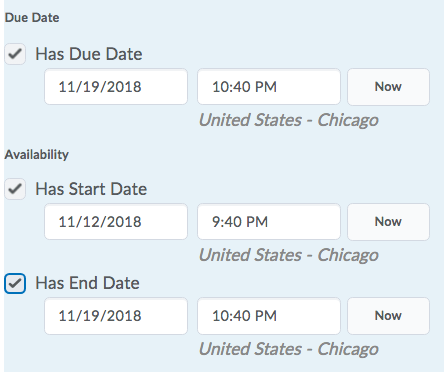
This post will describe the difference between Availability Dates and Due Dates and whether they are worth using in your online course.
Availability Dates
Availability Dates specify the time period when students can access assignments, quizzes, and discussions. Availability Dates have both a Start Date (when the assessment becomes available) and an End Date (when the assessment is no longer available).
Traditionally, students in online classes have about a week to complete a quiz or a discussion board post. The assessment typically becomes available on Monday morning, and it closes on Sunday night. The assessment is said to be “available” during this time. Students are not able to submit an assignment before the Start Date or after the End Date; they are able to access the assignment only during the specified time.
Availability Dates are used to pace students through the semester. Start Dates prevent students from submitting assignments too early, and End Dates prevent students from submitting all assignments at the end of the semester. Instead, students have to keep pace with the schedule of the online course, and they have to complete assignments each week during the specified time period.
Due Date
Traditionally, the Due Date is the last day students can complete an assessment for full credit. After the Due Date, students may lose some or all points on the assessment. For major projects, students usually lose a full letter grade if they submit the assignment after the due date. For daily homework, discussions, or quizzes, students usually lose all points if they don’t submit the assignment before the due date; however, students may be able to request a “make up” for a missed quiz or exam.
In terms of the LMS settings, the Due Date is a “recommended” setting that helps communicate expectations and manage the online class – ie, nothing happens on the LMS if the student submits an assessment after the due date. The LMS will indicate that the assignment is “Late,” but it’s up to the instructor to take action to deduct points for the late submission when they assign a score.
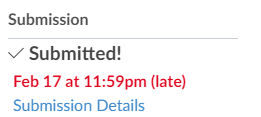
Due Dates and End Dates usually work together. For daily homework and quizzes where late work is not accepted, the Due Date and the End Date are the same. Once the Due Date passes, the End Date makes the quiz or assignment unavailable; in short, the student missed their chance to complete the assessment, and they will automatically receive a zero. (Settings for online quizzes typically don’t have “due dates;” they have only end dates.)
For major assignments where late submission is allowed, the End Date is set a few days after the Due Date. For example, the Due Date for Essay 1 could be set for Sunday Feb. 15, while the End Date could be set on the following Sunday on Feb. 22. In this case, students will be able to submit the assignment until Feb. 22, but they will lose points each day after Feb. 15.
Traditionally, online discussions have two due dates: one for the original posting and a second for the response. Unfortunately, LMS platforms don’t have many settings for online discussion boards – they don’t have two due dates. Instead, they have only an Availability Date, where the discussion is either available or not. As a result, the instructor will have to communicate expectations for discussions through other means (on the syllabus and through announcements), and the instructor will have to calculate deductions when assigning a score.

For discussions, some LMS platforms have a “read only” setting. This setting keeps the discussion board visible so students can read the discussion, but it does not allow students to make any more contributions.
Should You Use Availability Dates?
Availability Dates help keep students on pace with the course. Otherwise, students may procrastinate and try to complete all assessments at once, which would be unmanageable. Spreading out assignments throughout the semester helps ensure “regular” interaction in an online class, which is a fundamental expectation of distance education, according to the Department of Education, and it is also a best practice according to online course rubrics such as Quality Matters.
Without availability dates, students in an online class would also not have a shared experience or a shared class community if everyone is working on different projects independently. Discussion boards would not be synchronized, students can’t share resources about the same topic, announcements and assignment reminders would not be meaningful, and the instructor won’t be able to summarize completed discussions, clarify missed items on a quiz, or provide guidance on an up-coming assignment. The online class would break down into an individual, self-paced course.
If the assessment does not have an Availability Date, it will always be open. This always-open setting is necessary for ungraded discussion posts where students can share resources and ask questions. Some instructors also keep unit or weekly discussion boards open so students can continue the conversation even after the due date, though students may not earn additional points for sustained contribution.
The availability date for major assignments also usually stays open for the whole semester so students can view assignment requirements and work ahead, especially for classes that have a major research project at the end of the semester. Or, students may need to resubmit the assignment after the due date if they are revising it for a higher grade.
Quizzes typically have short availability periods. This helps ensure academic integrity, both so that quiz questions and answers don’t circulate publicly and also so that students don’t have too much time to look up answers and share them with classmates.
Should You Use Due Dates?
Many of the comments above about Availability Dates – maintaining regular interaction throughout the semester, creating a class community, providing opportunities for instructor feedback – also apply to Due Dates. Due Dates also carry consequences for grades. Students who miss a due date may lose some or all points for an assessment.
Traditionally, a missed due date resulted in a severe penalty, for several reasons: the student did not demonstrate effective time management and assignment planning, the student was not responsible, it was not “fair” for students who completed the assignment on time, late submissions were inconvenient for the instructor’s grading schedule and management of late submissions, and late submissions prevented the instructor from reviewing quiz answers.
However, many instructors are re-examining the value of the due date after the Covid pandemic. Instructors are realizing that the late submission penalty may be inequitably penalizing students for poor health or personal or financial or family circumstances instead of penalizing them for a lack of academic ability. In other words, students may be missing assignments because they have to work or take care of family and not because they don’t understanding how to complete the assignment.
Instructors are also realizing that a penalty on a single assignment may be so damaging that the student cannot pass the class with a high grade. If students incur this penalty early in the semester, they are likely to drop the course, and that contributes to the college’s overall lower retention and success rate. Instructors are now questioning whether the assignment penalty is worth the other consequences that follow.
Instead, instructors have been trying alternative methods, including the following:
No Penalties – Some instructors have stopped assigning penalties, and they now accept assignments at any time. However, I have heard anecdotally that students are struggling with the lack of deadlines. Students don’t know which assignments to focus on (there are no priorities), they have little motivation to complete assignments without the threat of a penalty, procrastination becomes too tempting, and they under-estimate the amount of time it takes to complete assignments.
Rolling Deadlines – Instead of collecting a specific assignment on a specific due date, instructors accept any assignment on a regular “submission day” such as every Friday. The instructor grades assignments as students submit them, without penalty, whenever the student submits the assignment, even if it is on the third or fourth submission week.
Lighter Penalties – Instructors are deducting fewer points for late submission. Instead of a full letter grade, they make deduct only a few points.
Longer Grace Period – Instructors may give an extra day or two to submit an assignment without a penalty. For example, instead of a penalty after Friday night, students may have until Monday morning to submit the assignment for full credit.
More Dropped Assignments – Instructors usually have one or two extra quizzes or assignments students can drop if they receive a low score. Now, students may be allowed to drop even more assignments.
Extra Credit or Make Up – Some instructors are now providing opportunities for extra credit, or they have more lenient guidelines for making up missed assignments.
Due Dates are still a useful component for communicating expectations and creating a shared class experience, but many instructors are now being more lenient with penalties for missed due dates.
Should You Adjust Due Dates?
Traditionally, instructors have extended a due date if they fell behind because of a snow day or illness or because students need more time with the assignment. They have also given extra time to individual students who were ill, had to travel for athletics, or needed extra time with the assignment. The LMS platform allows instructors to change the Availability Date and the Due Date and also to change these for individual students only.
But “should” you change the due date? Some instructors say it’s not “fair” for individual students to have extra time, so they change the due date for the whole class or for no one. Many instructors give individual students extra time if the student asks in advance. Some instructors give extra time only for academic reasons (the student is working with a tutor, needs extra time to understand a concept, the student wasn’t able to access library resources, etc.) but not for “personal” reasons such as work or family obligations.
Your Experience: How do you use Availability Dates? How do you enforce Due Dates? Do you allow extensions for individual students? Has your philosophy about Due Dates changed after the Covid pandemic?
Lirim Neziroski, Ph.D., MBA, MSIS is a higher education administrator, an education consultant, a writer, and a previous faculty member with expertise in higher education leadership, instructional technology, curriculum development, academic assessment, and leadership of academic and online programs. Contact Lirim for individual mentoring, assistance with writing and editing, and public speaking services.
 Lirim Neziroski
Leave a comment