The new semester at my college begins with an “all-staff” meeting and a professional development day for faculty. The day begins with a general address by the college president, information about each area of the college (enrollment, student affairs, facilities and operations, budgeting, fundraising) provided by each vice president, information by the vice president for academics and other academic leaders, a faculty union luncheon, and professional development workshops about instructional technology, academic assessment, equity and inclusion, and many other topics.
One of the meetings is also an hour-long division meeting hosted by the academic dean. This meeting is a great opportunity to set the tone for the new semester, create an opportunity for socializing, establish a presence with faculty, and provide valuable information. This post describes my talking points as the dean of an academic division for the new semester’s division meeting.
New Employee Introductions. Hiring a new full-time professor is a major accomplishment, and many people in the division were probably involved in the process. I like to begin by introducing new employees because it helps me recognize a group accomplishment, establish a social atmosphere, and create a sense of belonging for the new instructor. Talking about new employees also allows me to preview goals for that academic department and also to make some positive, hopeful statements.
Enrollment Information. Enrollments in higher education are like sales figures for for-profit businesses. The enrollment size helps place a college into a size category, and enrollments are how colleges measure their success and financial status. This information is also rarely shared with faculty. As a result, faculty are curious about enrollments, and sharing this information can help promote transparency and trust among administrators and faculty.
I specifically like to provide disaggregated enrollment information, point out positives, and identify challenges. I also like to compare the total enrollment size and trends of the division with the rest of the college. My division typically has a large number of online and dual credit courses, and I like to highlight the large contribution the division is making in these areas.
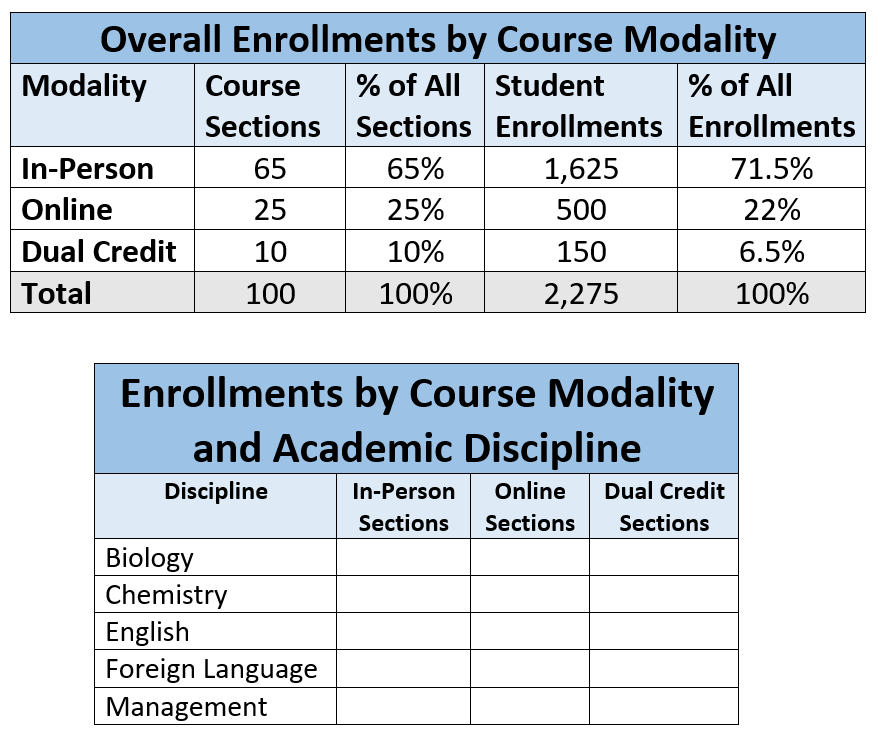
During my data presentation, I show the number of class sections and student enrollment numbers for each academic discipline, and I also disaggregate this data into “in-person,” “online,” and “dual credit” course sections. For dual credit, I also show the high school location and whether the course is taught by a college instructor or a high school teacher. The tables above demonstrate how I organize and present the information.
Examples of positive course information include new course sections we have recently added, course sections that are completely full, new courses/disciplines that are running (for example, one of our foreign language courses and an advanced music course is now running), and any other surprises or positive news. I also identify academic disciplines that have low enrollment, especially if there is a downward trend over several semesters. Declining enrollments in a particular area could lead to budget cuts and job losses, and it’s fair for instructors to know about these problems so they can help resolve the issue.
Request for Syllabi. Each semester, the dean’s office collects electronic copies of course syllabi. Deans review each syllabus to verify that it provides accurate information, such as the course code, course description, and course outcomes. At many schools, this material is standardized and official, and it must be presented to students as it appears in the college catalog. The dean also reviews syllabi for useful information about the college and the course. These include information about specific assignments, classroom behavior policies, late/make-up assignments/exams, any Covid-related policies, academic honesty, disability services, and much more. Not every school requires all of the same material, but it’s useful to have this information on the syllabus, and the Dean usually reviews it for accuracy and to provide suggestions about what to include. The Dean’s Office also keeps syllabi on file in case a student has a question or complaint about a course. Additionally, the college or academic department may be required to submit syllabi to accrediting agencies for periodic review; the Dean’s Office serves as a repository for these documents. During the division meeting, I remind instructors to email their syllabi.
Office Hours and Contact Information. Instructors are required to hold “office hours” each week. Office Hours are time the instructor has designated to meet with students, either in-person on campus or virtually. The dean keeps a record of instructor office hours in case a student asks and also to verify the amount of time they are available (the teaching contract specifies how many hours is required; it’s often about one hour per course or about five hours per week). I review office hours to verify that instructors are accessible at a reasonable time (such as before or after class).
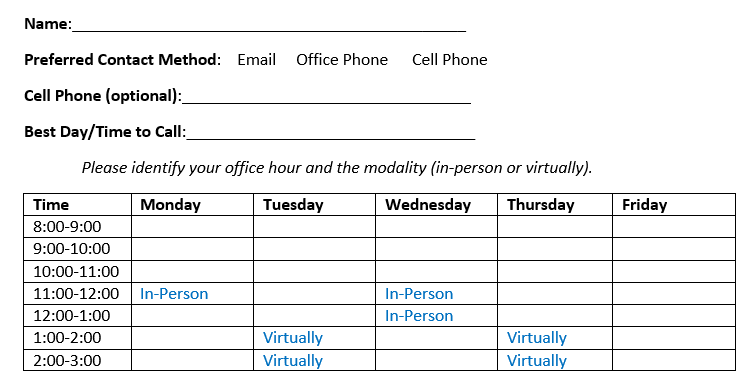
I also personally like to know when instructors are in the office in case I need to call or drop by. During the division meeting, I hand out a weekly schedule so instructors can identify their office hours. I also ask them to update their preferred contact method, especially if they are using a personal cell phone number.
Annual Goals (Division Strategic Plan). The beginning of the school year is a great time to establish expectations. I do this by reviewing the division’s strategic plan. This document contains a list of major projects that will need to be accomplished during the year.
- Many plans are broad and apply to the whole division. For example, every department should participate in academic assessment, so one strategic goal can be to “Increase Participation in Academic Assessment.” And a specific target could be “At least 75% of faculty will submit an assessment document,” or “Every department will submit an assessment for at least three courses in that division.”
- Some strategic plans are specific to a particular discipline or department. For example, English or Psychology may have to write a program review, so the strategic goal will be for those reports to be completed on time.
- Some strategic plans don’t belong to the academic division specifically, but they are aligned to a broader college goal. For example, the college may be trying to grow its online presence, so the division may contribute by moving all courses in a program to a fully online format.
When identifying strategic goals, I try to sound hopeful and excited about the great things we’ll do. I avoid suggesting that it will be a lot of difficult, time-consuming work. Fortunately, I really enjoy strategic planning, so I sound positive and hopeful anyway, and this helps to set a positive tone for the new year.
While talking about strategic goals, I also like to review accomplishments (and setbacks) from the previous year. Doing this provides transparency, an informational update, and closure to the previous year. When goals have been met, it also allows me congratulate everyone and to demonstrate that the strategic plan is not impossible.
Tenure Reviews. Each year, a group of instructors goes through a review process as part of the tenure cycle. Instructors are always on a review cycle, but they have specific requirements they must meet during specific years (often 3 or 5 years) in order to receive tenure or advance in their academic career. Requirements vary by academic institution, but they often include a written reflection or portfolio, a classroom observation, student feedback surveys, and reviews of scholarly work such as conference presentations and published journal articles. I notify instructors individually about major deadlines that are approaching, but I also identify during the division meeting the instructors who have deadlines in this year.
Reminders about Administrative Processes. The Dean’s Office facilitates and monitors many administrative processes related to employees, classes, and academic programs. During the division meeting, I ask coordinators and administrative assistants to provide a brief overview on how to do things, such as cancelling an in-person class due to illness and requesting reimbursement for conference expenses.
Important College Announcements. Important college-wide information was provided at the all-staff meeting, but I also like to provide my own reminders about new and important information. For example, during the Covid pandemic, the college had many policies about vaccines, masks, social distancing, and Covid-positive instances, and I provided this information again during the division meeting. Other examples include major upgrades to campus technology, such as new office phones or new instructor lecterns in the classroom.
Questions and Open Discussion. During the division meeting, there are always questions, and I designate time at the end for questions; instructors can also ask questions during other parts of the meeting too. I also ask instructors to describe how they handle certain situations. For example, in the post-Covid era, many in-person classes still had Covid-related attendance and assignment/exam make-up policies. Since these policies vary throughout the college, I ask instructors to volunteer examples of their class policy so others can see a range of approaches. We may also discuss concerns related to enrollment, course syllabi, assessment, the strategic plan, and anything else.
Instructor Information Sharing. At the very end, I ask instructors to contribute anything else they would like to share. The Fine Arts area, particularly, always hosts theatrical, musical, and artistic events on campus, and this is a good opportunity to advertise their events. Many instructors also talk about their summer research and travel, some talk about their work in the local community, and of course there are always many personal updates about kids and family.
Lirim Neziroski, Ph.D., MBA is a higher education administrator, education consultant, and previous faculty member with expertise in higher education leadership, instructional technology, curriculum development, academic assessment, online programs, and strategic planning. Contact Lirim for consulting, research, writing, and public speaking services.
 Lirim Neziroski
Leave a comment