I am writing a series of blog posts about the effects of Covid-19 on higher education. In this post, I explore the effects of Covid-19 on faculty. For many instructors, the transition to online teaching was a big shock. All of a sudden, they had to master something they had been ignoring for decades, and they had to recreate their instructional material for the online environment. As a result, many instructors report feeling overwhelmed and burned out, and they also lost touch with aspects of university life they enjoyed the most – interacting with students and colleagues.
More Work
The transition to online caught many professors by surprise. At my small liberal arts university, for example, professors prided themselves on their ability to make a strong personal connection with students in the classroom. They had practiced the skills of dynamic lecturing, story-telling, and student engagement, and they avoided online teaching on purpose.
Some instructors even felt safe because their classroom or academic program could not be moved to the online environment. My university had a new, state-of-the-art science building, and it was a major attraction for students in science and healthcare fields. They enjoyed the hands-on, experiential learning, and my university had become known for this kind of learning. Fine arts classrooms in pottery, drawing-painting, sculpture, music, and also high-tech classrooms for digital music production and graphic design also depended on the expensive technology and recording studios that could not be replicated in the online environment.
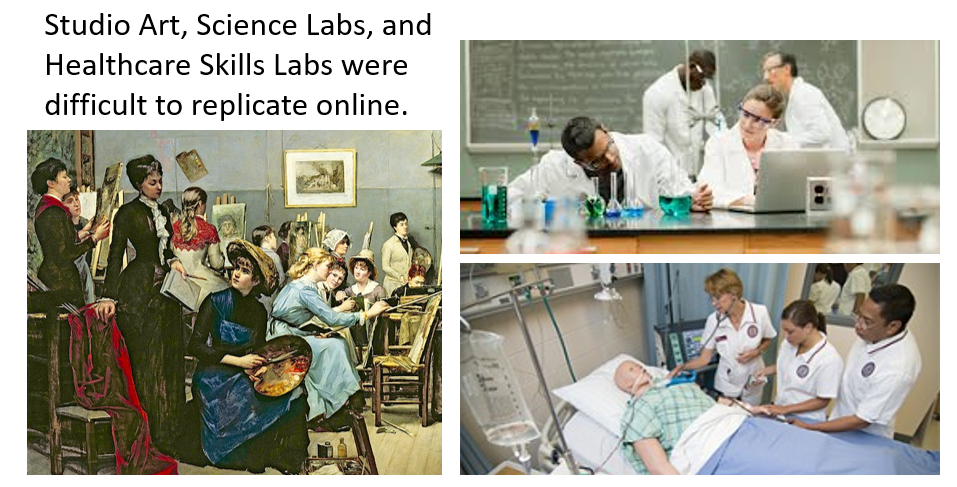
All of a sudden, the transition to online forced these instructors to learn about strategies for online teaching, to learn to use the technology itself, to design online courses, and to transform their lecture content into online activities and recorded videos. Obviously, this was a lot of work. Instructors who had created well-detailed lesson plans now had to recreate that material into an online format, plus learn the technology, plus teach and grade, plus provide support to their students, plus handle logistical issues if they served as program coordinators.
Different Type of Work
During this time – and even now – instructors told me that they “did not sign up” for this kind of work. What they really enjoyed was teaching in a classroom, facilitating discussions, and developing relationships with students. This is all possible to replicate online as well, but instructors felt like novices in the online environment in contrast to their skill for classroom teaching.
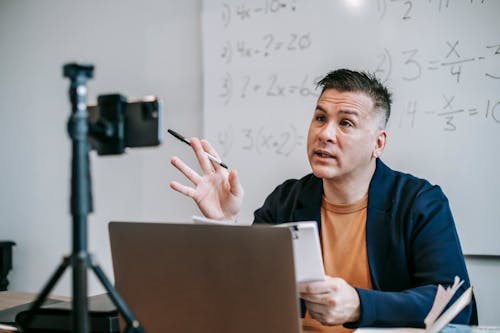
The nature of the work was different in other ways as well. Instead of lecturing to live audiences who responded verbally or with body language, instructors were speaking to a computer screen, or they were recording videos in front of a camcorder or cell phone. Instead of leading a classroom discussion or question-and-answer session, instructors communicated over email, video conference, phone call, or online discussion board. Instead of helping students complete their science labs or clinical skill activity, instructors demonstrated these skills in front of a camera.
Senior instructors who also served as program coordinator were constantly doing administrative work. They had to find laptops and webcams for their part-time faculty, they had to make decisions about clinical courses, internships, service-learning projects, classroom speeches, science labs, and more. They had to find software for video conferencing and online exams. They had to respond to questions from students and other faculty. They had to rearrange budgets to meet the new demands. At the same time, they also probably had to serve on faculty and administrative committees that were responding to the Covid-19 crisis, budget restrictions, possible layoffs, enrollment declines, and more.
At my small liberal arts university, where the primary role of tenured professors is to teach, the era of Covid-19 asked them to complete a lot of administrative tasks.
Student Counseling
In addition to the new work of online instruction and also the complex and new administrative duties of rearranging clinical and laboratory courses, instructors also had to provide a lot of student support.
Of course, on a regular basis, the instructor is the primary contact person for a student. The instructor sees the student on a regular basis, and the instructor can see the student’s classroom performance and emotional-psychological condition like no other person on campus. Nevertheless, students have many other resources in an in-person environment. During the Covid-19 shutdown and transition to online, students lost this easy contact with university support staff (such as athletic coaches, tutors, resident assistants in the dorms, and student activities coordinators), and the only solid connection that remained was to the instructor.
As a result, the instructor was the person who fielded questions about the university’s Covid response, about science labs, about clinical courses, about internships, about graduation, and even about dorms and athletics. And it was the instructor who took on a primary role of locating online technology for students (webcams, video conferencing software, online textbooks, Library access, academic support resources, at-home lab kits, and more) and arranging alternatives to clinical and internship courses.

This need for support required that instructors have a new and broad understanding of the university. Instructors could no longer easily refer students to the Student Success Center. They now had to find online student resources, and they had to work with students individually to locate and access these resources.
Instructors also needed a new and more sensitive understanding of their students as well. For many instructors, the transition to online provided the only glimpse into a student’s home life … as they caught parents or children in the background of their video conference, or as students told them about family members who were laid off work or sick with the corona virus. These interactions required instructors to display sensitivity, emotional intelligence, and compassion, which are aspects of their personality they probably did have not to display in the classroom, laboratory, or clinical setting.
Burnout
In many academic journals – including The Chronicle and Inside Higher Ed – the overall response from faculty was burnout from the large amount of work, anxiety about a new style of teaching, and also mental health of their own because of concerns related to employee layoffs, budget cuts, projections about declining enrollments, and their own health concerns for themselves and their families.
Some faculty members themselves were in high-risk populations because of their age or their pre-existing medical conditions, so they were extra concerned about their own health risks. If they were not at-risk themselves, they may have been taking care of elderly parents who were at-risk. Many instructors also had school-age children, and they had to help their own children with online learning, video conferencing, homework, and basic parenting necessities such as lunch and snack time and read-aloud sessions.
Feedback
If you are a faculty member, what was your experience during the Covid shutdown and move to online? Or, if you work at a higher education institution, what were the experiences of your faculty during this time, and how did they respond? Feel free to post a comment below, or email me directly using the Contact page.
Lirim Neziroski, Ph.D., MBA is a higher education administrator, education consultant, and previous faculty member with expertise in higher ed leadership, instructional technology, curriculum development, academic assessment, program leadership, and strategic planning. Contact Lirim for speaking, consulting, and writing opportunities.
 Lirim Neziroski
Leave a comment