I am writing a series of blog posts about the effects of Covid-19 on higher education. One of the biggest casualties during this time was enrollment. Many schools went to all online or remote learning formats, so students were not able to attend classes physically. But even in an online format, many students chose not to return for another semester. Some universities are also purposefully recruiting and admitting fewer students as well.
Overall
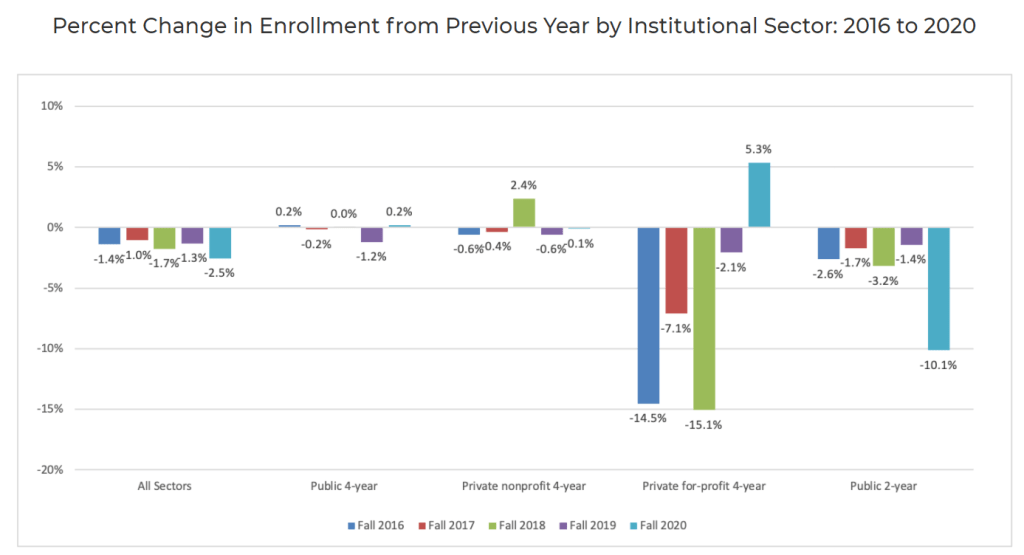
According to the National Student Clearinghouse Research Center, overall enrollment for Fall 2020 declined by 2%. Community colleges had the biggest decline, with a 10% decrease in enrollment from the previous year. Meanwhile, private non-profit colleges and state four-year universities were mostly flat. Private for-profit colleges had a 5% increase.
First-Year Students
Fewer students chose to start their college career in Fall 2020. According to the National Student Clearinghouse Research Center, overall enrollment for first-year students was down by 13%. For first-year students over the age of 24, it was down by 30%.
The overall first-year enrollment was down by 8% at state universities, down by 10.5% at private colleges, and down by 21% at community colleges.
Only private for-profit colleges had an increase in first-year students with a 9.5% increase. However, the overall number was relatively small for these schools in comparison to state institutions. Overall first-year student enrollment at for-profit colleges was only about 36,600, while the total number at community colleges was about 780,000 and about 930,000 at state universities.
Fall 2021 enrollments may also be low. Many students submit their college applications in October and November, and they file their FAFSA before the end of the year. But The Chronicle reports that both college applications and FAFSA applications for next year are low. FAFSA applications are down by 10%.
Low-Income and Minority Students
Covid-19 has affected low-income and minority students the most. According to an Inside Higher Ed article from Dec. 2020, low-income and minority students in community colleges have been “cancelling their plans” or are planning to take fewer courses. The article reports that 40% of students were planning to drop all of their courses for Spring, and another 15% will be taking fewer courses. Low-income students were twice as likely to change plans as higher-income students.
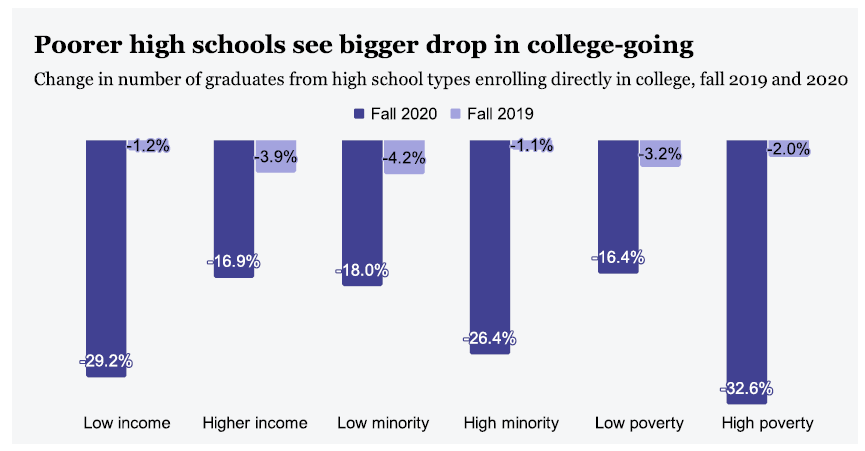
Common reasons for not enrolling in school include fear of catching the virus, needing to stay at home to take care of family members, lack of financial support, and changes with their schedule at work.
A researcher from Columbia University comments in the article that the decision not to attend college can increase equity gaps even more. According to the researcher, these students are “going to come out of a pandemic with even fewer skills … [and] be in an even worse position than before.” Columbia University also posted this blog article about how students are changing their plans for community college.
Community Colleges
Community colleges had the largest drop in enrollment. About 500 thousand fewer students attended community college between Fall 2019 and Fall 2020, according to the National Student Clearinghouse Research Center. But community colleges lost 21% of first-year students, which represents 200 thousand students.
Some geographic areas were hit even harder. Here is a list of states with the highest enrollment losses. In Illinois, 45 of 48 community colleges had a “substantial” decline student enrollments, according to an article in the The Chicago Tribune. The article reports that the overall decline in Illinois was a 14% decline. Many community colleges in the Chicago area, where I work, had an even larger decline, with five colleges (according to this article) reporting a more than 20% decline in enrollment for Fall 2020.
Graduate School
According to the National Student Clearinghouse Research Center, overall enrollment in graduate programs increased in Fall 2020 by about 3.5%, and it increased by about 4.5% at state universities. But a Feb. 1 article from The Chronicle reports that over 50 graduate programs are “pausing or pulling the plug” on admissions for Fall 2021 in the humanities and social sciences. Here is a recent list of universities that have suspended graduate admissions.
Graduate programs have also been hurting because less funding has been going to academic institutions in general. This means there is less government support for research universities and more competition for grants and private donors.
One positive note for graduate programs is that graduate degrees have been increasing for minority students. According to Inside Higher Ed, Ph.D. degrees for minority students increased by 7% in 2019, while it increased only 3% overall. However, the overall head-count number is still very low. Minority students accounted for about 10% of the Ph.D. graduating class, with about 5,500 graduates in a class of over 55,000 students. Women also earned about a third of Ph.D. degrees in the sciences and about 25% of Ph.D. degrees in engineering, math, and computer sciences.
For new graduates, Covid-19 also means fewer post-docs, fewer jobs in academic research, more part-time and contingent jobs, and possibly more than one job.
Online
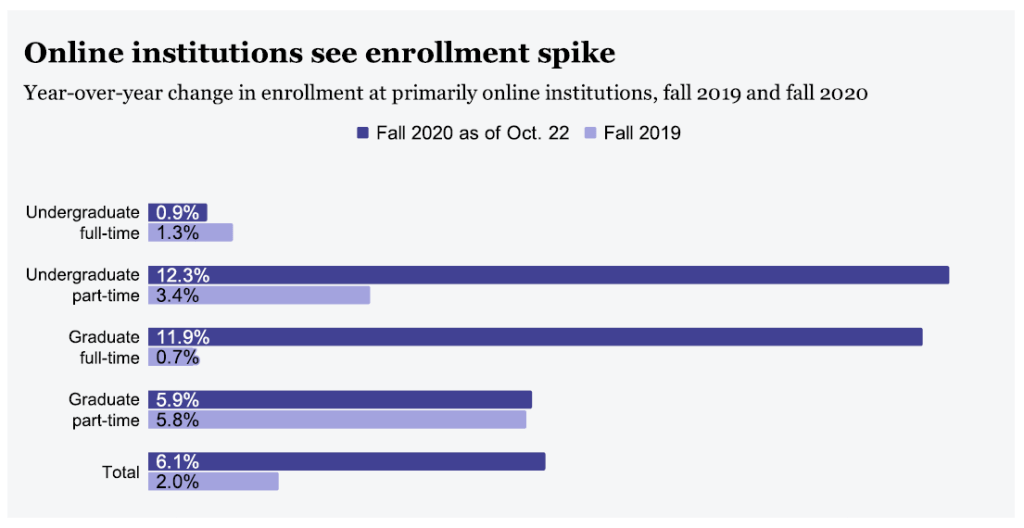
With much of the country moving to online, remote, virtual, or hybrid learning, online programs have been the only ones that have seen an increase in enrollment. According to this article from Higher Ed Dive, overall enrollment in online programs has increased by nearly 6%, and some programs have increased by well over 10%.
International
Enrollment for international programs was already low even before Covid because of immigration restrictions by the Trump Administration. But it is now even lower because of Covid. International programs have declined 15% overall, and new international student enrollment has declined by 43%, according to this Chronicle article from Nov. 2020.
A more recent Chronicle article from Jan. 2021 shows that college applications from China are down by 18% for Fall 2021. There were large increases from other countries (22% from Canada, 23% from the UK, 28% from India), but the total number of students is relatively small in comparison to the number of students from China.
Lirim Neziroski, Ph.D., MBA is a higher education administrator and previous faculty member with expertise in instructional technology, curriculum development, academic assessment, program leadership, and strategic planning. Contact Lirim for speaking, consulting, and writing opportunities.
 Lirim Neziroski
Leave a comment