One of my goals for 2020 was to read more. I read about two hours each night, and I read 45 books altogether. I read mostly popular non-fiction books about personal productivity, business management, education, and a few novels I had on my bookshelf. In this blog post, I summarize the popular non-fiction and business books I read.
Malcolm Gladwell
Malcolm Gladwell is one of the best and most influential writers in America. I have been reading his works since my college days, and I regularly listen to his podcast. In 2020, I decided to begin my reading list by reading his most famous books cover to cover.
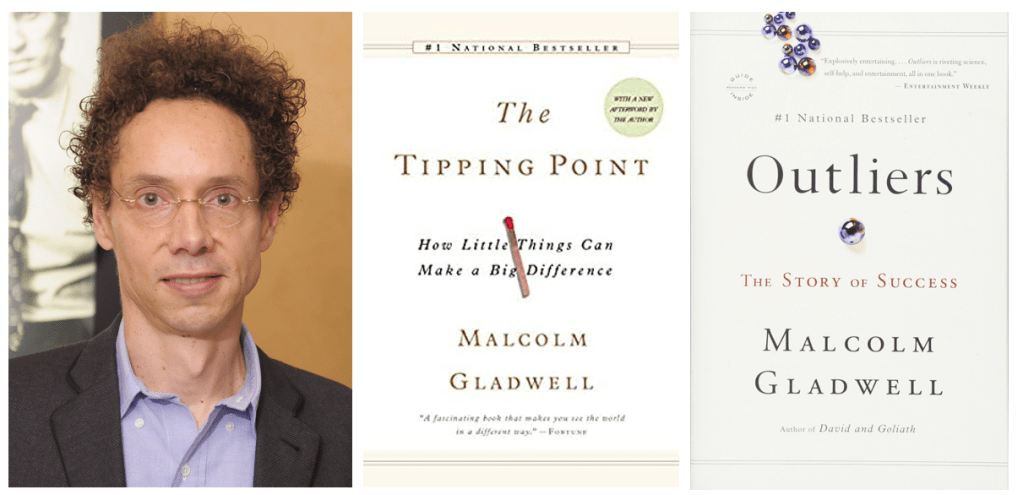
The Tipping Point. The Tipping Point was a very influential book, and I had already read some individual chapters, such as his famous chapter about the New York City crime rate. Gladwell explores “how little things can make a big difference.” He argues that every event has a “tipping point” which he defines as “the moment of critical mass, the threshold, the boiling point” that makes ideas and products “spread like viruses” (“go viral). Gladwell describes three types of people who have an extraordinary amount of influence on how ideas are spread. He calls them “connectors” (people with large social networks), “mavens” (people with a passion for something specific), and “salesman” (people who promote a specific idea or make it famous). In another section, Gladwell describes the “stickiness factor” of ideas themselves; these are attributes an idea has that makes it more likely to go viral. They include being a story that is surprising, easy to remember, and slightly familiar already. This book was very influential and well written, and Gladwell’s ideas of a “tipping point” and the “stickiness factors” have influenced other books; “tipping point” has even become common phrase in our everyday speech.
Outliers. Gladwell continues to explore how people become successful in Outliers. In this book, Gladwell explores how highly successful people, such as The Beatles and Bill Gates, who are at the very top of their field became successful. Gladwell argues that highly successful people are both very lucky to have a unique set of opportunities and they also spend a lot of time in training through sustained deliberate practice. For example, The Beatles performed live for several years in Amsterdam before they became famous in the U.S., and Bill Gates had access to one of the first mainframe computers in the country. Gladwell argues that people like The Breatles and Bill Gates became successful because they spent 10,000 hours practicing their skill. This book has become very well-known for popularizing the 10,000 Hour Rule. I wrote about this book and the 10,000 hour rule in my newsletter as well.
Blink. In Blink, Gladwell continues to explore attributes of successful people. In this book, he explores how expert judgment is developed, and he describes problems that are caused by expert judgment. Examples of expert judgment include a tennis coach who can determine the outcome of a serve, art dealers who can spot a fake, and a marriage counselor who can determine if a relationship will be successful. These expert judgments depend on something Gladwell calls “thin slicing,” a way of analyzing very important data very quickly. The book also explores how expert judgment can be wrong. Gladwell describes how fingerprint analysts and art dealers can overlook important details and make inaccurate conclusions. This book provided a further explanation of success, but I didn’t think it was as great as The Tipping Point and Outliers. I would recommend all three books nevertheless.
Tom Peters – In Search of Excellence
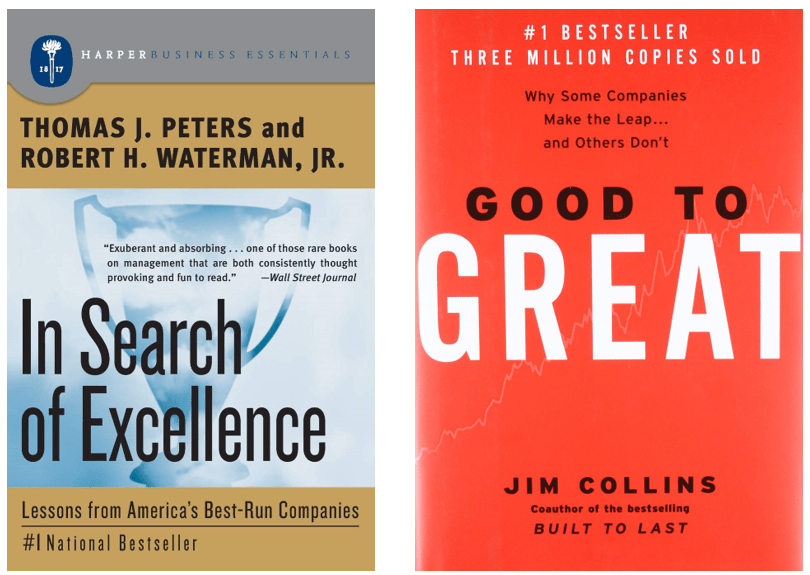
In Search of Excellence is a classic book about business and organizational leadership. The book was written by a McKinsey consultant and now famous business writer. Each chapter describes a strategy for business principles that helps make the business excellent. These include a bias for action, an understanding of the customer, focusing on employees, keeping a small and flat organizational structure, and doing only the things the organization can do very well. This book has been very influential in analyzing business strategy, and it made Tom Peters very famous for going against McKinsey strategy by focusing on “soft” skills.
Jim Collins – Good to Great
In a similar book, Jim Collins identifies components of great organizations that allowed them to have long-term business success. Common characteristics include a “Level 5” leader, a focus on mission and values before goals and actions, an honest analysis of fact, a focus on the activities the organization does best, and a culture of discipline. This book has also been very influential in identifying effective business practices, but both Good to Great and In Search of Excellence have also been criticized because many of the businesses they identified are now struggling or out of business. Nevertheless, even these writers admit that success cannot be sustained forever.
Clayton Christensen

Clayton Christensen was a business strategy professor at Harvard Business School. He is best known for his research on innovation. I read three of his books in 2020. He is a very systemic thinker and his writing is very clear and engaging. I enjoyed all three books, but the two innovation books are a little too academic for a popular book.
The Innovator’s Dilemma. The innovator’s Dilemma describes the process of innovation in successful organizations. Christensen demonstrates that innovation happens in organizations that provide value to low-end customers and then eat away the customers and profits of more established businesses. New, innovative business start by providing quality at lower prices, and they continue to improve quality until they reach a more mainstream market and can raise prices. Ironically, this allows established businesses to shift their focus to high-end customers (where the profit is higher), and this makes established businesses even more vulnerable to an attack from the low-end. The book is very well researched; it focuses on the innovations in semiconductors, personal computers, and American steel mills, and helps clarify the process of business innovation and strategic growth.
The Innovator’s Solution. The Innovator’s Solution continues with the ideas of the previous book by demonstrating how organizations can have continued success through innovation. The problems Christensen identifies is that large organizations that have high expenses cannot survive on small-scale innovation because the innovative product does not bring enough revenue to cover expenses. Instead, Christensen argues that an organization should break off its innovative department into a separate business entity that can be profitable with little revenue. Christensen also demonstrates the need for continuous innovation at the low end to keep other innovators from taking away business.
How Will You Measure Your Life? The third book I read by Christensen was more of a personal book. Christensen takes the idea of goals and measures from the business organization, and he demonstrates how you can reflect on the successes in your life. I found the book very interesting and inspiring. Christensen summarized business theory and demonstrated how those ideas could be applied on a personal level.
Andy Grove – High Output Management
Andy Grove was the long time, highly-influential and successful CEO of Intel during the 1990s. He invented a process of goal setting and measurement he calls “Objectives and Key Results” (OKR), and this book describes how this practice can improve business management. The book also describes many other processes used in production and manufacturing, such as throughput time. The book has been influential for its goals and measures, but it was not the most engaging or clear to read.
John Doerr – Measure What Matters
John Doerr was one of Andy Grove’s Vice Presidents at Intel, and he has gone on to work with Google and many other large organizations in Silicon Valley. In this book, he describes Andy Grove’s process Objectives and Key Results more fully, and he provides many examples of how today’s successful business organizations have used this strategy. I wrote about goal-setting in one of my newsletters as well.
Atul Gawandi – The Checklist Manifesto
The Checklist Manifesto demonstrates how organizations become more successful when they use a checklist to promote quality. Gawandi describe several examples in the airline industry, manufacturing, and healthcare where checklists have increased safety and quality. I wrote about The Checklist Manifesto in one of my previous blog posts.
Peter Thiel – Zero to One
Peter Thiel was a co-founder of PayPal, and he has become an influential venture capitalist and business thinker. His book is based on a course he delivered at Stanford, and it describes strategies for launching a new organization. Some of the ideas that were most influential for me are the idea that people believe in progress but they are hesitant to take action, and the idea that success comes from creative thinking about what can be new.
Richard Koch – Star Principle
Richard Koch was a long time consultant with Boston Consulting Group, and he has now become a very successful business investor and business writer. He is most well-known for his book The 80/20 Principle, which expands the famous Pareto Principle about the distribution of data to the business and financial world and to everyday life . In Star Principle, Koch argues that people can become rich by investing in a business is that is a market leader. The book provides very practical strategies for identifying star businesses, and it also provides thought exercises for creating star businesses.
I enjoyed reading these books, and I learned a lot about success both in business and in general. I read about 45 books in 2020 in the areas of education, business management, personal productivity, and a few fictional novels. Summaries of books in all these areas will be coming soon.
Lirim Neziroski, Ph.D., MBA is an academic administrator and faculty member with expertise in instructional technology, curriculum development, assessment, and strategic planning. Contact Lirim for speaking, consulting, and writing opportunities.
 Lirim Neziroski
Leave a comment