One of my goals for 2020 was to read more. I read about two hours each night, and I read 45 books altogether. I read mostly popular non-fiction books about personal productivity, business management, education, and a few novels I had on my bookshelf for a long time. In this blog post, I summarize the books I read about education.
David Robson – The Intelligence Trap: Why Smart People Make Dumb Mistakes
The Intelligence Trap describes theories and beliefs about intelligence over the last 100 years. The book begins by describing the belief of a natural-born intelligence, but it goes on to criticize this idea of a “general intelligence” (the I.Q.). Robson explains the history of how a specific type of testing in a limited number of academic subjects created the measure of a “general intelligence.” He says that IQ tests (and modern tests, like the SAT) focus on a few very specific skills on information recall and analysis.
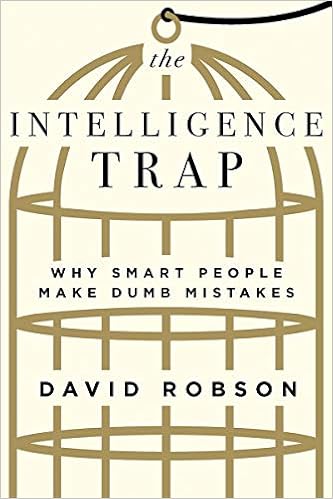
Robson goes on to explain how this idea of “general intelligence” (the I.Q.) has been criticized. He gives examples of people with very high I.Q. who have not been successful, and he describes forms of learning (in non-American and non-European cultures) that promote different forms of “intelligence.” Other criticisms of “general intelligence” include the idea of “multiple intelligence” (which expands the definition of intelligence to include athletic ability and many other skills) and the recent emphasis on “emotional intelligence” (which expands the definition of intelligence to include emotional skills).
Much of the book also describes problems with very specialized knowledge and analytical skill. For example, Robson describes how an expert’s analytical ability (a system of thinking that has become second nature) can cause a person to overlook important information. He also describes common biases and other beliefs experts may hold.
This was the first book I read in 2020. I hadn’t read a comprehensive book about intelligence and learning, and this book taught me a lot about research on learning and the many problems that can happen, both in the process of learning and because of too much learning. It’s a useful book, and it’s written for a general audience. I would recommend it.
Natalie Wexler – The Knowledge Gap
Natalie Wexler describes many problems in student learning (especially in the learning of high-level skills such as analysis), and she argues that these problems are caused by focusing too much on skill development (such as reading, writing, and research) and not enough on content knowledge. The book strays a little too much into educational policy; Wexler describes the influence of specific people, organizations, and educational policies that have promoted skill development and have criticized “low-level skills” of memorization and recall. I wasn’t too interested in the criticism of educational policy, but her explanation about the skills vs content debate was very well done.

One of the parts I remember very clearly is her description of students who cannot write effective paragraphs. She says that they can write correct sentences, but the logic of their ideas is not clear. She argues that these students write ineffectively because they don’t have enough knowledge about their topic. She also describes examples where writing improves as students learn about the topic; she claims that students naturally go into deeper levels of analysis and synthesis as they learn more and more about the topic.
This book’s ideas about teaching content and skills would be useful for anyone going into a teaching career. The book will help you think about the nation’s debate between focusing on skills (such as math, writing, reading) and focusing on content knowledge (which is often criticized as low-level memorization).
Brown, Roediger, McDaniel – Make it Stick: The Science of Successful Learning
Make it Stick describes strategies to increase learning ability. The strategies include retrieval practice, “interleaved learning” (learning about more than one subject), embracing difficult learning moments, and more. The book can help students learn effective study strategies. Teachers can benefit from the book too – they can provide recommendations to struggling students. (The book is very similar to Chip & Dan Heath’s Made to Stick.)
William Ford – God, Pharaoh, and Moses
This book provides analysis and commentary about the Plagues of Egypt scene from The Book of Exodus in The Bible. The book argues that the plagues were sent by God so He could reveal Himself to the Egyptians and Israelites. This argument goes against some traditional beliefs about the plagues as punishment and as a negotiation strategy to make the Pharaoh change his mind and free the Israelites. I read this book to learn about plagues in the ancient world for a project I was working on, and I learned quite a bit.
Jared Diamond – Germs, Guns, Steel

This was one of the best books I read for 2020. Diamond describes differences in the American and Afro-Asian continents, and he argues that these continents are so different because of environmental and societal factors. Environmental factors include the East-West vs North-South layout of the continents, the early availability of crops and domestic animals, and the ways people used natural materials such as steel. Diamond also identifies cultural differences such as the invention of writing, diseases, and agricultural vs nomadic lifestyles. The evidence in this book was very thorough and specific. This book was also used as the class textbook for an academic program I supervised at my college. I wrote about the ideas in this book in my weekly newsletter: Part 1, Part 2, and Part 3.
Yuval Harari – Sapiens
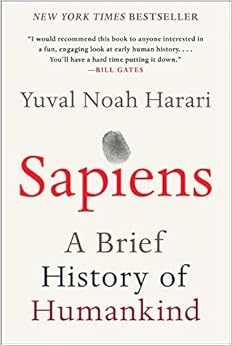
Sapiens is a best-selling book about “Big History,” a study of history that spans from the big bang to the present. Harari describes major events in human history, such as extinction of other species of humans (did you know there were seven species of humans?!), the agricultural revolution, and the development of civilizations. The book was very thought-provoking in the way Harari critically evaluates and criticizes many events in human history. For example, he argues that life was simpler and meals were more healthy before the sedentary, agricultural lifestyle. He also raises ethical questions about the relationship between surviving and extinct human species. I wrote about the ideas in this book in my weekly newsletter.
Lyotard – The Postmodern Condition
The Postmodern Condition helped define the postmodern period. It begins by evaluating the value of scientific and technological research; Lyotard questions whether these fields actually advance society any further or whether they primarily conduct experiments to reaffirm existing beliefs. Then, the book expands into philosophical commentary about a culture’s stories (“meta-narratives”), and it argues that these stories are not longer effective … that societies are in a post-cultural-narrative time period. I found the text philosophical and abstract in many sections, and it surprisingly focused too narrowly on scientific and technological research. I read this book as background information on another writing project I was working on. I think other books and articles about postmodernism (by Jean Baudrillard and Fredric Jameson) do a clearer job of describing its characteristics.
Paul Moses – The Saint and the Sultan
This book was a gift from my supervisor. It describes the meeting between St. Francis and the Egyptian Sultan during the Crusades, and it describes the influence the two had on each other. The book provides a lot of biographical history about Francis and about his belief in non-violence. Moses argues that Francis was interested in going to Egypt so he could spread Christianity among the Muslims, but he also ended up learning a lot from them; he learned to respect their religious faith, their daily prayers, and their hospitality. He also critically evaluated the (political?) goals of the Catholic Church in attacking Egypt during the Crusades. Moses identifies the influence Francis and the Sultan had on each other (such as lenient treatment of war prisoners and greater concessions at the peace treaty), and he describes the legacy of peace the Franciscan brotherhood has had over the centuries. I thought the book mostly repeated the biography of Francis (there are several chapters on Francis’s life) and was one-sided towards Francis. Nevertheless, it provided an insightful analysis of a historical moment.
Tara Westover – Educated
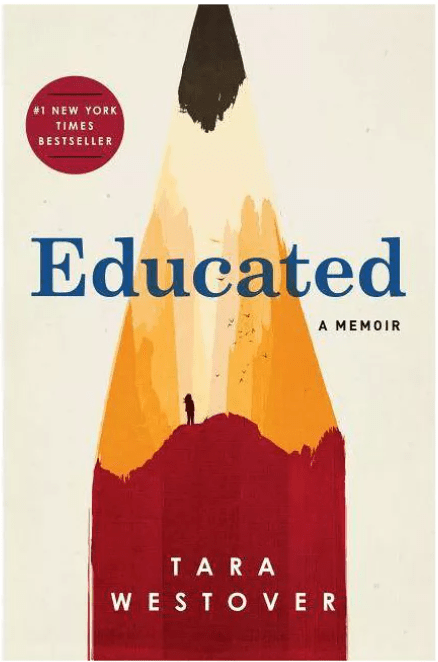
Educated is Tara Westover’s best-selling and multi-award-winning memoir about growing up, and leaving, her abusive Mormon family in order to attend prestigious universities. The book was a free gift at a conference I attended. I had heard about the book’s transformative power, and I was hesitant to read it; it was one of three books I kept on my office desk for about a year. The writing is gripping in narrative story-telling in many sections, as Tara describes her family conflict. Tara became self-educated, and she won fellowships to Cambridge and Harvard.
The book includes many deeply insightful reflections on learning and family, but the its large focus family conflict and violence overwhelms these comments. After a while, I found myself passing judgment on her decisions, and I wasn’t able to relate to her story as much. I think the book would have been much more interesting to me if I were younger… I found myself thinking about her parents’ experiences quite a bit, and this kept me from sympathizing with Tara’s comments in some sections.
I enjoyed reading these books on education, and I learned a lot from many of them. I read about 45 books in 2020 in the areas of education, business management, personal productivity, and a few fictional novels. Summaries of books in these areas will be coming soon too.
Lirim Neziroski, Ph.D., MBA is an academic administrator and faculty member with expertise in instructional technology, curriculum development, assessment, and strategic planning. Contact Lirim for speaking, consulting, and writing opportunities.
 Lirim Neziroski
Leave a comment