The Midwest First Year Conference is a regional conference for First-Year Experience programs. On Sept. 27, 2019, several FYE faculty and program coordinators from my school attended the conference at Illinois State University and gave presentations. In a previous post, I wrote about the keynote address by John Gardner and Betsy Barefoot. In this post, I would like to summarize my presentation in which I describe my school’s FYE program and explain how the program helps us meet strategic and assessment goals.
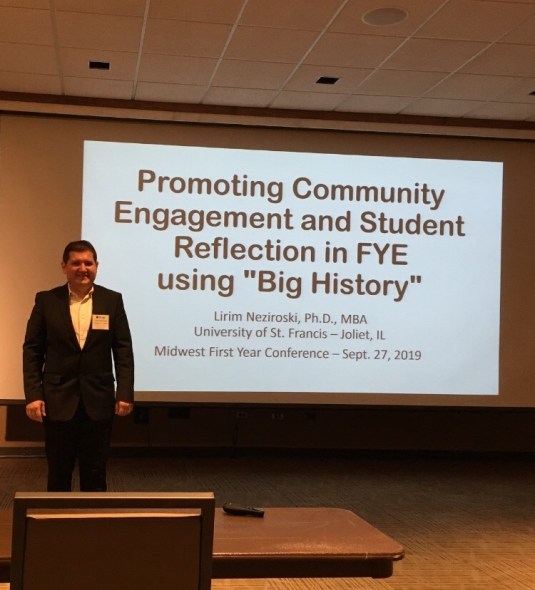
Promoting Community Engagement and Student Reflection in FYE using “Big History”
My university’s FYE program has three major components: “Big History” curriculum, a service-learning project, and information and strategies for a successful transition to college.

Big History – “Big History” is a multi-disciplinary approach to the history of everything. Students learn about the whole span of history from the Big Bang to the present. As they do so, they develop learning skills in the areas of reading and note-taking, examination of the relationship between claim and evidence, analysis of perspective and scale, and an evaluation of narrative and storytelling. While learning the major events in history, students also write short reflection assignments.
Learn more about Big History by reading David Christian’s foundational article “The Case for Big History” and several Big History books on the market. You can also consult the Big History Project website, which is a free resource for course content, activities, and assessments.
- David Christian, et al. Big History: Between Nothing and Everything.
- David Christian. Maps of Time: An Introduction to Big History.
- David Christian. Origin Story: A Big History of Everything.
- Cynthia Stokes Brown. Big History: From the Big Bang to the Present.
- Yuval Noah Harari. Sapiens: A Brief History of Humankind.
Throughout the program, the material about Big History is used as the course content, and students apply skills in reflection, writing, note-taking, and more. Here are a couple examples:
- Evidence of the Big Bang. One of the first chapters of the textbook describes the scientific evidence about the Big Bang. Students read the material and take notes on the information, then they are asked to reflect. First, they are asked: “What is the evidence for the Big Bang?” “Why do scientists believe it is reliable?” “What questions still remain?” This portion of the assignment is mostly asking students to demonstrate their understanding of how evidence supports a claim. Then, students are asked to personally evaluate the evidence. “How does my belief or denial of this evidence affect my attitude towards academic disciplines that study this early history?” In other words, the reflection is asking students to explain why they do or do not value the scientific evidence and to reflect on how that belief influences their appreciation of the academic discipline.
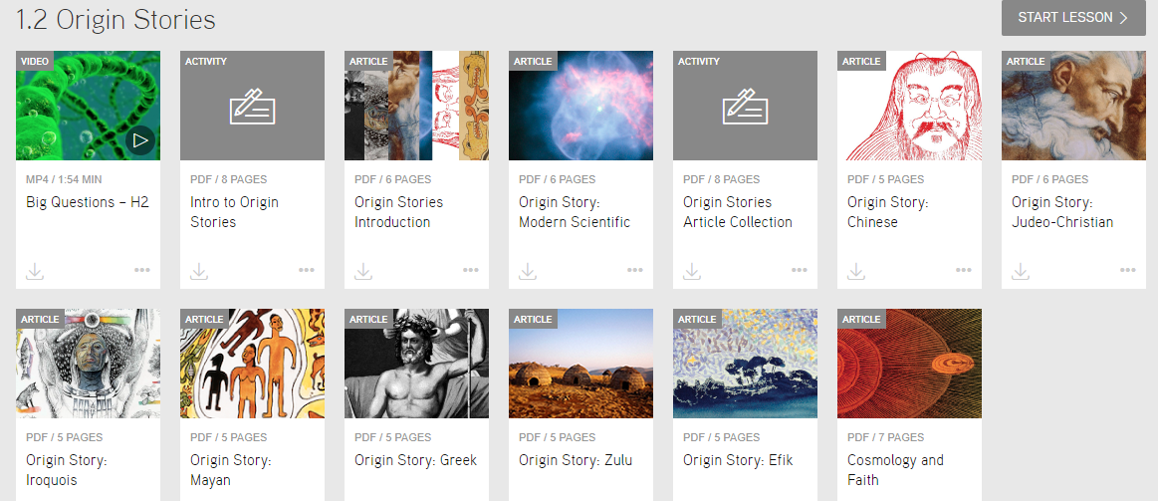
- Origin Stories. Another section in the early history of the textbook focuses on origin stories from different cultures. Students are asked to read and compare these origin stories, to describe what the origin story tells about that culture, and to reflect on the importance of an origin story. Questions include: “Why is there such an importance placed on where things/people come from?” “What function do origin stories have?” “How would you write your own origin story?” “What is there from history and your own personal past that gives significance to your life and helps you to understand where you are coming from?” “How does this origin help to guide your future? Your decisions? Your values?”
Service-Learning – Service-Learning is an applied learning method where students learn a course concept by creating a project for a community partner. In our FYE program, students select a topic, identify a need in a community organization, and create a project to help meet that need. Throughout the assignment, students reflect on what they are learning about the topic and about the community organization, and they also reflect on how their own learning is developing. While the Big History content makes students reflect on the whole history of the cosmos and the universe and the planet and the development of life on Earth, the service-learning project makes students focus on a specific topic and on a more specific community.
College Transitions – The third component of the FYE program helps students make a personal connection to the university community. It does this by helping students learn about the university’s mission and values and about services offered at the university (such as financial aid and the library). During this time, students also learn about academic skills that will help them become successful students; these include note-taking, time management, relationship development (and Title IX issues), and more.
Overall, my presentation described how these three components of the FYE program help students grow academically and personally. The course content, activities, and assignments help students make broad connections to the whole universe and specific connections to the community and to the university. These connections also help to bond students to the university … and our university benefits in strong student relationships, higher satisfaction, and higher first-year retention.
Feedback
Describe your school’s First-Year Experience program.
Lirim Neziroski, Ph.D., MBA is an academic leader at a liberal arts university in the Chicago area. He is an expert at curriculum development, assessment, academic technology, and strategic planning. Contact Lirim for additional resources and for speaking, consulting, and writing opportunities.
 Lirim Neziroski
Leave a comment