In my final post about the 2019 NISOD Conference, I would like to share a few comments about my impression of Austin, TX. This was the first time I went to Texas, and it took a while for Austin to grow on me.
A Relaxing, Big “Small Town”
I arrived in Austin ready to do business. The NISOD Conference was one of the biggest venues I have presented at, and I was focused on my presentation, on the importance of this conference, and on networking. I was surprised that Austin was so small (in comparison to Chicago or Atlanta, I suppose) and that it was so empty. I kept asking hotel and restaurant staff where “the big companies” and “the big money” of the city are, but I kept receiving the response that “Austin is not like that.”
I am familiar with big cities, like Chicago and Atlanta, that have clear, wealthy, powerful corporate buildings and executives walking around in power suits, and I kept looking for signs of that in Austin. But I didn’t find it. Instead, Austin had a very relaxed “small town” feeling. People were not walking around in suits, rushing to get to work or another meeting. There were very few cars on the road, no taxis, no buses, no underground shuttles or subways. There were also very few people. Those who were on the streets were going to restaurants and bars.


The physical size of the city was also pretty small. I walked from the river to the Capitol building and from one side to the other several times. There were several tall buildings, mostly hotels, but no Willis Towers or other mega skyscrapers. Since I covered the whole city on foot, I became connected to the whole city, and it started to feel like a small town that I started to know intimately.
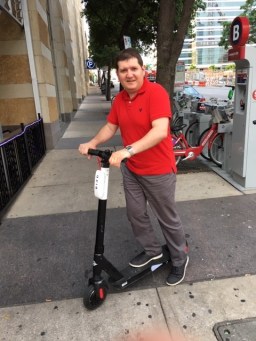 The Scooters
I guess the scooters are now everywhere (listen to Scott Stratten’s description of urban scooters on his Un-Marketing podcast), but I had not seen them before. I spent an afternoon trying them out, and I enjoyed them. They helped me explore the city, and their quick acceleration gives a little surge of excitement and fun!
The Youth
Austin is a very “young” city, and I was very surprised by this. Everywhere I looked, I saw “millennials” and “young adults.” Young people in restaurants, in the street, at parks, in bars, riding scooters. This was a big contrast from many Midwestern towns and cities I have seen, and it made me feel like I was a “senior citizen!”
According to the World Population Review, the median age in Austin is 32 years, and the largest age demographics are 20-40 years old, with 25-30 as the highest demographic.
Local Businesses
Except for the hotels and Starbucks, all of the restaurants and businesses felt very local. I saw no fast-food restaurants (such as McDonald’s or Taco Bell), no national food chains (such as Chili’s or Applebee’s or Buffalo Wild Wings), and no national brand stores (such as Target – I think I saw Walgreens…). Overall, almost all of the bars and restaurants and stores were local businesses, and each establishment had a unique character. This helped build the “small town” feeling as well – it helped make the city feel “organic” and original rather than commercialized.
The Homeless
I was also surprised to see so many homeless people. I have heard of a rise in homelessness in Los Angeles, and I suppose Austin’s proximity to the Mexico border, the warm weather, the economic conditions, and maybe the city’s support services (according to a local news station, the city spent $33 million in 2018) help maintain a homeless population, but I was surprised to see so many homeless people early in the morning as I walked to the conference hotel, and I was saddened by it. According to GateHouse News, there are over 2,200 homeless people in Austin – this is an increase of 5% from 2018 and an increase of 23% since 2015.
The homeless seemed to have a community. Many were interacting with each other and with people in the streets, and they were all very friendly and interesting people.
Lirim Neziroski, Ph.D., MBA is an academic leader and an assessment and technology expert at a liberal arts university in the Chicago area. Contact Lirim directly for additional resources and speaking, consulting, and writing opportunities.
 Lirim Neziroski
Leave a comment